
Scientific Journal
Document Type : Research Paper
Authors
1 Associate Professor of American Studies, University of Tehran, Tehran, Iran
2 PhD in North American Studies, University of Tehran, Tehran, Iran
Keywords

This is an open access work published under the terms of the Creative Commons Attribution-ShareAlike 4.0 International License (CC BY-SA 4.0), which allows reusers to distribute, remix, adapt, and build upon the material in any medium or format, so long as attribution is given to the creator. The license allows for commercial use (https://creativecommons.org/ licenses/by-sa/4.0/)
1. Introduction
Intelligence plays a central role in shaping national security decisions; yet it is also inherently uncertain (Betts, 2007, p. 19). Assessments and analysis of threats such as weapons of mass destruction (WMDs), terrorism, and cyber operations are often fragmented, partly unknown, and incomplete. For decision makers, and especially for US presidents, this uncertainty and incomplete information presents a challenging and sometimes opportune situation. It is challenging because policy decisions must be justified based on incomplete information, and it presents an opportunity because persuasion becomes a tool for legitimizing those decisions. In this context, presidential rhetoric is not just descriptive; It is a strategic act designed to interpret intelligence, frame threats, and build public and elite consensus for specific courses of action (Betts, 1978; Zegart, 2007, pp. 1-11). The US presidency has a unique position in this regard. Unlike legislators, who may discuss competing interpretations of intelligence, the president must serve as a singular authoritative voice that shows both urgency and direction. (Aguilar & Schiemann, 2020, pp. 253-254). When intelligence is uncertain or contested, persuasion could function as a bridge between classified analysis and public justification. In such situations persuasion becomes a tool for executive decision makers. As noted by Betts (1978, p. 61), “intelligence failures are inevitable”, but what matters politically is not only what intelligence shows but also how leaders frame its meaning. The presidential voice is therefore not passive; it shapes and constructs reality by directing others how to interpret threats and adversaries, and construct responses and political actions.
This article examines the ways in which Presidents George W. Bush (2001-2009) and Barack Obama (2009-2017) used persuasive methods to address intelligence-related uncertain and incomplete matters. Both presidents faced critical moments where ambiguous or disputed intelligence influenced national security debates. For Bush, the most notable examples included the aftermath of the September 11, 2001 terrorist attacks, the justification for the Iraq War based on claims about Iraqi WMDs, and broader discussions of the ‘war on terror’. Bush's rhetorical challenge was to persuade the public, Congress, and allies that urgent threats required decisive, often preemptive, action (Johnson, 2007; Zegart, 2007, pp. 1-11). In contrast, Obama confronted intelligence challenges in a different era, defined less by large-scale invasions than by covert operations, drones, targeted killings, and cyber threats (Byman, 2013, p. 1). His speeches in these instances emphasized the importance of careful judgment, multilateralism, and trust in institutions to address nontraditional, evolving, and new threats. Obama's rhetorical goal was to persuade audiences that strategic patience, reasoned consideration, and reliance on institutional and expert credibility provided security in a context of intelligence challenges.
In this research, uncertainty is defined as an inherent characteristic of intelligence. This study argues that intelligence matters are mostly uncertain for the public and even for analysts and politicians. Regarding Bush, the existence of WMDs in Iraq was unknown to the public (Koenig, 2023, pp. 9-12). At that time, it was an unknown and uncertain issue for the CIA, intelligence agencies, and Bush himself. Intelligence analysis is fundamentally based on probability. Therefore, this research posits that WMDs were uncertain and unknown at the time of public speeches. In cases related to Obama, details about mass surveillance by intelligence agencies were top secret, and even after the Snowden leaks, most details were never confirmed by officials. During the speeches, the extent and depth of surveillance were not known to the public or politicians (Lyon, 2014, pp. 1-4). In the context of Obama and drone attacks, target selection was also based on probability, which explains the reason for which in some cases, civilians or unintended targets were hit (Boyle, 2013, pp. 7-9). This research asserts that all cases where the president needs to persuade others involve unknown or uncertain matters. Even in the best scenarios, decisions were based on intelligence analysis, which, most of the time, relies on probability. Thus, this study examines how these two presidents interpret intelligence, which is often secret, uncertain, and sometimes unknown to the public.
These contexts support the central question of this research, that is, how do presidents adapt their persuasive strategies when intelligence is uncertain, incomplete, or controversial? Specifically, what persuasive methods distinguish President’s Bush's style of communication from that of President Obama? The primary objective of this study is to understand the mechanisms that Presidents Bush and Obama utilized to persuade or deceive others about the unknown elements of intelligence and their related activities. To comprehend their persuasive methods, it is necessary to analyze the rhetorical techniques they utilized, their use of language to manipulate, the narrative, as well as the structure they employed to transfer their viewpoint or influence public opinion. This article addresses these questions by applying a new seven-category persuasion framework with 25 subcategories to the analysis of presidential speeches. This framework expands the Aristotelian triad to capture the ways in which persuasion operates in these intelligence cases and their contexts. It integrates insights from classical rhetoric, political communication and cognitive psychology, offering a more systematic tool and framework for studying persuasion.
The contribution of this article is twofold. First, it offers a theoretical contribution by refining the study of persuasion beyond ethos, pathos, and logos. Second, it offers an empirical contribution by systematically comparing two presidents in different intelligence contexts. The article proceeds as follows. The next section reviews the existing literature on persuasion and presidential rhetoric, highlighting both strongpoints and gaps. The methodology section then describes the data and coding framework, explaining how the new seven-category model was used on Bush and Obama's speeches. The findings section presents the comparative results, showing the patterns of persuasion in each president's discourse. The discussion examines these findings within broader debates about leadership and intelligence, and the conclusion summarizes the study's contributions and suggests directions for future research.
2. Literature Review: Presidential Persuasion and Intelligence Challenges
A significant amount of research has examined presidential rhetoric and persuasion. Much of this work is based on Aristotle's classic model of ethos (credibility), pathos (emotion), and logos (reason). Scholars have shown how presidents use language to legitimize wars, justify political actions, and influence public opinion. For example, research on Bush highlights his use of moral clarity, religious undertones, and urgency to justify military intervention after 9/11 (Ivie & Giner, 2007, p. 585). In contrast, Obama is portrayed as a president who relied on metaphor, storytelling, and institutional ethos to persuade audiences in a more thoughtful style (Rowland & Jones, 2011, pp. 133, 147). Ghazani (2016, pp. 631-646) found that Bush and Obama both used a wide range of persuasive strategies but embedded them in different ideological frameworks. Jaradat (2022) showed that Obama's nomination speeches emphasized inclusivity (Jaradat, 2022, pp. 33, 42), while Bush's rhetoric leaned on fear and security (Goussios et al., 2014, pp. 178-179). Khajavi and Rasti (2020, pp. 2, 12), using critical discourse analysis, argued that Obama often invoked collective narratives such as the ‘American dream’, while opponents like Mitt Romney relied more on negative representations.
Beyond the classical Aristotelian triad, scholars have also expanded their analysis to include specific techniques and persuasive strategies used by presidents. Researchers noted that modern presidents employ a variety of rhetorical devices, from storytelling and historical analogy to humor and symbolism. For example, Bush’s speeches after 9/11 often invoked simple heroic narratives and biblical archetypes to demonstrate his country's actions as part of a grand moral mission. His style projected decisiveness and certainty (Skiles, 2007, pp. 49, 81, 77). In contrast, Obama used a rhetoric of democratic exceptionalism that emphasized cooperation, partnership, discussion, negotiation, openness, and transparency (Vaughn & Mercieca, 2014, p. 131). In summary, previous research indicates that while both presidents employed a diverse range of rhetorical strategies, they integrated these tactics into distinct communicative personas.
Persuasion becomes important in the field of national security and intelligence communication. Intelligence-related crises, such as warnings about weapons of mass destruction (WMDs), technological threats, or emerging cyber dangers, confront presidents and decision makers with uncertainty. Unlike legislators, who may debate about intelligence related matters, the president must deliver a clear interpretation of the facts to guide policy and reassure the public. Indeed, as Aguilar and Schiemann (2020, pp. 261, 266) observe, presidency holds a unique communicative role. When intelligence is incomplete or disputed, the president’s voice is expected to project both urgency and direction as the nation’s primary storyteller-in-chief. Scholars of intelligence and foreign policy have noted that intelligence is inherently imperfect and could lead to ‘failures’. As Betts (1978, p. 61) famously argued, such failures are unavoidable because leaders must make decisions under conditions of ambiguity.
For exampl the 9/11 Commission Report detailed how systemic flaws left leaders with fragmented warnings before September 11, 2001, forcing the Bush administration to construct a narrative that would mobilize a response despite the gaps (Cooper, 2007, p. 1). Scholars like Jervis (2006) argue that when faced with inconclusive intelligence, leaders may resort to ‘trategic lies’ or fearmongering to preempt doubt and justify their preferred course of action (Jervis, 2006, p. 28). Persuasion acts as a link between intelligence classification and the public, translating uncertainties into politically actionable certainties.
Despite these valuable insights, the literature has three main limitations. First, it often relies narrowly on Aristotle's triad, treating ethos, pathos, and logos as fixed categories rather than strategies that can be subdivided into more detailed methods. Viewing them as broad categories can mask important details, such as which emotions are triggered (fear versus hope), which ethical values are highlighted (personal credibility, patriotism, religion, etc.), or what types of logical arguments are preferred (data driven reasoning, historical analogy, cause-and-effect logic). Some recent works have begun to address this by examining specific persuasive techniques (such as narrative framing, metaphor usage, or humor in speeches). However, the field still lacks a systematic framework that captures the full spectrum of persuasive strategies that presidents use in security-related matters.
Second, studies often focus on isolated speeches like inaugural addresses or campaign debates instead of systematically analyzing a broader collection, such as inaugural address, a State of the Union discourses, or a speech on a single crisis. This case-specific approach may overlook patterns in how presidents adapt their rhetoric to different contexts. A more comprehensive, comparative perspective is therefore needed to see consistency in presidential persuasion over time and across different domains.
Third, very few works specifically place persuasion within the context of intelligence, where secrecy, deception, and strategic framing are crucial. The literature on intelligence highlights the inherent challenges leaders face when dealing with uncertain or classified information. One scholar argues that intelligence failures are not simply due to incompetence; rather, they are structurally inevitable because decision-makers must act under ambiguity (Betts, 1978, p. 88).
The unique constraints of intelligence, like secrecy, technical complexity, and ambiguity, pose challenges for persuasive communication in this field. This is a gap that could become even more pronounced if we considering misinformation and conspiracy narratives. Persuasion allows leaders to shape public opinion. However, despite its significance, there are few systematic frameworks for analyzing persuasion in this domain. This study aims to fill these gaps by using a new framework to compare the persuasive methods of two presidents in their intelligence contexts.
3. Methodology: A Multi-Layered Framework for Analyzing Presidential Persuasion
The study's methodological approach is rooted in an interpretivist philosophical approach (Guba & Lincoln, 1994), which is believed to be, according to the author of his article, the most useful for exploring persuasive methods and rhetorics. This philosophy emphasizes understanding subjective meanings within a social, historical, and cultural context, and is appropriate for studying socially constructed phenomena (Guba & Lincoln, 1994, p. 110). The goal of this research is not to understand the effect of persuasive methods on an audience, but to model the presidents' persuasive approaches by interpreting the methods they used. The research design employs a mixed qualitative methodology, integrating qualitative content analysis to inductively identify themes and patterns in the presidents' speeches; at the same time, a deductive content analysis enables a structured examination of predefined persuasive methods.
3. 1. Sampling and Four-step Coding Process
The study builds two datasets from speeches of two presidents from The American Presidency Project. It starts with a clear definition of the ‘subject of persuasion’ (moments where a president tries to shift public beliefs/attitudes about an intelligence-related, such as Iraq/WMD-related or surveillance). Because the database is massive, the sampling is narrowed in a controlled way:
1. Keyword filtering using a small set of highly relevant, context-specific keywords per president: keywords that are extracted and sorted based on importance and relation with the context or “subject of persuasion”, such as WMD, Saddam, Iraq, Surveillance, and Drones.
2. Based on the American Presidency Project database filtering ability, filtering to keep solely formal and related speeches (for example, news conferences, addresses, executive orders, and more), in a way that the material is comparable and relevant.
3. Manual review to remove irrelevant speeches even if they match the keywords.
After this three-step relevance screening, the final dataset consists of 162 speeches for Bush and 150 for Obama, which are then examined using qualitative content analysis as the main method, with both inductive and deductive logic built into the coding.
Although entire speeches were identified through keyword filtering, the unit of analysis in this study was not the full speeches, but the relevant excerpts within them. Only the segments that directly addressed the cases were extracted, segmented, and coded. Irrelevant portions of each speech were excluded from analysis. This ensures that the coding reflects only the pertinent rhetorical content rather than the speech as a whole.
The coding itself is a four-stage pipeline that moves from broad, descriptive tagging to precise classification of persuasive techniques.
Stage 1 (Descriptive/Open Coding): An initial, inductive phase where speeches were read, and broad, context-specific themes and keywords were identified to summarize relevant content. The researcher read each speech and applied initial, flexible labels (short keywords/phrases) to capture what is being said related to the ‘subject of persuasion’, especially contextual signals and who/what the persuasion is aimed at (for example ‘Foreign policy’, ‘Deterrence’, ‘military action’). The term ‘subjects of persuasion’ in this study refers to the issues, policies, or perceptions that the President seeks to reshape in the minds of others.
Stage 2 (Action–Motivation Coding): The data was recategorized based on the four persuasion targets of the Action–Motivation Model, revealing strategic patterns on which the presidents chose to focus. The coded parts of speeches are re-read to reorganize the material around who is doing what and why, splitting content into four categories: Persuader’s Actions, Persuader’s Intentions, Subject’s Actions, and Subject’s Intentions. As a result, each passage is connected to an actor-intent structure instead of the topic by itself.
3. 2. The Action–Motivation Model
This process involved applying a new analytical tool: the Action–Motivation Model. This model categorizes persuasive acts by their strategic objective, providing a framework for understanding the underlying goals of presidential rhetoric. This model is rooted in Attribution Theory from behavioral and social psychology (Heider, 1958; Jones & Davis, 1965). Attribution theory suggests that people interpret events by attributing them either to external behaviors and circumstances (Action), or to internal dispositions and intents (Motivation). This study operationalizes these psychological concepts into a coding scheme to track how presidents direct audience attention related to their persuasive strategy. The model distinguishes between the observable (Action) and the inferential (Intention) across two agents: the self (The President/US) and the adversary (The Subject).
This new model divides all persuasive communication into four distinct ‘Persuasion Targets’:
- Persuader's Action: When the president justifies or explains his own actions or policies.
- Persuader's Intention: When the president emphasizes his own motivations, character, or goals.
- Subject's Action: When the president discusses or critiques an adversary's actions.
- Subject's Intention: When the president discusses or critiques an adversary's motivations or character.
This model is essential for linking rhetorical methods to strategic goals. For example, finding that a president heavily uses a specific persuasive method, such as a fear appeal in the context of discussing a ‘subject's intention’, could reveal a persuasive strategy of demonizing an adversary's motives to justify his action. This moves the analysis beyond simple description and helps segment the speeches and code the persuasive methods better by understanding the context.
Stage 3 (Contextual Concept Coding): each persuasive part of speech is given another broader concept label, and categorized based on combining the Stages 1 and 2 to give it a code and subcode. This continues until the coding reaches saturation, producing thematic clusters. For example, the code and its subcode were ‘Persuader’s action: Containment’ or ‘Persuader’s: Action: Justifying intelligence failure’ or ‘Subject’s Action: Concealing Evidence’.
It is important to remind readers that these three stages of coding purpose are to help the researcher improve qualitative analysis by categorizing and subdividing speeches for data interpretation.
Stage 4 (Persuasive Methods Coding): Finally, each persuasive-related part of the presidents’ speeches is coded using a predefined list of 25 persuasive methods. This stage is explicitly deductive and is applied carefully (with historical and contextual attention) to identify persuasive tactics for each unit. The end result supports pattern comparison between Bush and Obama and allows comparing the persuasive methods emphasized by each president.
3. 3. The Seven-Category Persuasion Framework with Twenty-Five Subcategories
The core of this study's methodology is a seven-category persuasion framework with 25 subcategories, designed to expand and refine the traditional Aristotelian triad of ethos, pathos, and logos. This framework was developed by systematically combining and adapting various persuasive methods found in persuasion studies literature. It offers a more systematic tool for qualitative analysis.
The seven categories in the framework proposed by research are derived and expanded from Aristotle's ‘Triad of Persuasion’. To strengthen its theoretical foundation, this study operationalized Aristotle's classical concepts by aligning them with modern communication theories, and expanded its categorization to align with the current theoretical framework. This framework is not an arbitrary collection of categories, but a specialized tool designed to capture the nuance of US presidential rhetoric. This new 7-category framework and its subcategories are not a general theory and framework for studying persuasion, but the researcher, after rigorous analysis, believed is suited to studying US presidents' persuasive strategies. The reason for categorizing and building the framework on Aristotle's triad is that it provides the researcher with a more precise tool to deepen the analysis of persuasion and better connect speeches and their persuasion strategies with the political, cultural, and social context in which a US president delivers a speech. Especially in the context of world studies and the analysis of a foreign president, this framework could facilitate a foreign analyst’s analysis in developing a more precise coding method for studying a president from another country.
Consequently, the study first categorizes Aristotle's logos into three subcategories. ‘Logical and Rational arguments’ have the most direct link with Aristotle's Logos. In ‘Framing and Distorting’, the study argues that because they can directly manipulate perceptions of rational choice, this is connected to Aristotle's Logos ideas. Framing, based on Prospect Theory (Levy, 1997, pp. 87-88), is used to make a policy decision appear logically superior by altering the audience's reference point; based on this logic, this categorization could be derived from and linked to the Logos idea as well. ‘Questioning and Skepticism’ in the context of persuasion: Questioning and challenging the ‘facts’ or the ‘logic’ of an idea, argument, policy, or political action of an adversary, targeting the perception and persuading the audience based on the ‘Central Route’ if it is perceived through the ELM model of persuasion for the audience (Perloff, 2020, p. 231). Using this method, the president structures the audience's thinking, forcing them to arrive at a logical conclusion (by dismantling or questioning alternative assumptions). As a result, this also could be linked to Logos.
Appeals to ‘Character and credibility’ and ‘Social and Cultural Appeals’ in this framework are derived and linked to Ethos. However, this framework expanded the Ethos idea of Aristotle into these two aspects. The first part, which focused on credibility and Moral Appeals, addressed the speakers' characteristics and actions. This is the core appeal to the speaker's authority (institutional trust and legality) and moral Character. However, it added another layer: Social and Cultural appeals. In this category, the outer aspect of a political action is targeted. Meaning, similar to credibility and Morality, which are concentrated around the speaker himself or his country, Social and Cultural appeals point to the compatibility and alignment of a political action or motivation with others and the society. This category draws on Social Identity Theory (Ellemers & Haslam, 2012, p. 379), extending Ethos from the individual character of the president to the collective values of the nation; it extends Aristotle's Ethos from individual characteristics (the president) to collective values (the nation/group). By aligning policies with shared traditions and national pride, the president harnesses the audience's sense of shared moral character to legitimize the action.
Persuasion using Pathos, in Aristotle's framework, is achieved by moving the audience emotionally. This dissertation breaks this idea into two general categories and subcategories. The first part is the ‘Emotional Appeals’, which is completely aligned with the theory's idea of Pathos. However, this research framework included ‘Narrative and Symbolism’ and its subcategories. Narrative and drama techniques in literature and art are used to deepen emotional connection. 'Narrative and Symbolism' incorporates insights from Narrative Transportation Theory (Thomas & Grigsby, 2024, pp. 1806-1807). The symbolism and narrative of this dissertation's framework are linguistic and artistic forms that move the audience's emotions through the speaker, that is, the president. For example, anecdotal evidence humanizes abstract arguments, while vivid imagery and metaphors evoke emotional responses by bypassing pure rationality, making abstract threats feel visceral and immediate.
As shown, the framework presented in this research is not in conflict with Aristotle's persuasion theory and framework. However, using ideas from other persuasion theories such as ELM, Framing theory, Prospect Theory, and Narrative framework, it tried to add a new layer, as well as new tools to the previous framework in order to enhance it and make it suitable for scholars who are not familiar with the linguistics, cultural, and social context of a president in another country; this allows scholars to have a more precise view about the strategy of persuasion and use a variety of theories to analyze any US president’s strategic speeches and narrative.
The framework is organized into the following seven main categories and their respective subcategories:
A: Logical and Rational Arguments: This category includes methods that appeal to reason and evidence. The five subcategories are:
- Evidence-Based Reasoning: Using factual data, statistics, or empirical evidence to support claims (Brown et al., 2010, p. 125).
- Cause-and-Effect Analysis: Demonstrating how a specific action leads to a particular outcome (Mayne, 2011, p. 1).
- Analogies and Comparisons: Relating unfamiliar concepts to known ideas to enhance understanding (Ching, 2010, p. 312).
- Deductive and Inductive Reasoning: Moving from general principles to specific cases (deductive) or generalizing from specific instances (inductive) (Goswami, 2010, p. 282).
- Call to Action: Directly urging the audience to take immediate or future action (Borchers, 2012, p. 424).
B: Emotional Appeals: These methods are designed to evoke an emotional response in the audience. The four subcategories are:
- Fear Appeals: Highlighting threats or dangers to motivate action through fear of negative consequences (Williams, 2012, p. 1).
- Hope and Aspirational Messages: Using hopeful and positive imagery to inspire confidence and move toward desirable outcomes (Chadwick, 2015, p. 601).
- Anger and Indignation: Eliciting anger or moral outrage to galvanize support against an opponent or injustice (Brinton, 1988, p. 81).
- Empathy and Compassion: Encouraging understanding and emotional connection by emphasizing the plight of others (Stephany, 2022, p. 1).
C: Credibility and Moral Appeals: This category focuses on building the speaker's credibility (ethos) and moral authority. The three subcategories are:
- Appeal to Characteristics: Highlighting the qualifications, integrity, or moral character of oneself or an organization (Clark, 2003, pp. 6, 7).
- Appeal to Authority or Expertise: Referencing respected figures, organizations, or institutions to lend legitimacy to claims (Glenn, 1986, pp. 52-53).
- Ethical and Moral Appeals: Framing arguments as morally superior or emphasizing principles of fairness, justice, or responsibility (Verbeek, 2006, pp. 9-10).
D: Social and Cultural Appeals: These methods align arguments with shared societal and cultural values. The three subcategories are:
- Social Appeals: Positioning a policy as desirable based on its popularity, majority support, or alignment with social norms (Downing, 2006, pp. 158-161).
- Cultural Appeals: Aligning arguments with cultural values, traditions, or shared beliefs to resonate with the audience's identity (Rigby & Lee, 2024, pp. 7-10).
- Nationalistic Appeals: Using patriotism or national pride to persuade, emphasizing national identity and achievements (Yoo & Lee, 2020, p. 4).
E: Framing and Distorting: This category encompasses techniques for reshaping a message to enhance its persuasive impact. The five subcategories are:
- Distorting: Misrepresenting or exaggerating an opponent's position to make it easier to criticize (D'Errico & Poggi, 2012, p. 461).
- Simplifying Complex Issues: Reducing multifaceted problems into clear, understandable narratives or binary outcomes (Niederdeppe et al., 2014, p. 432).
- Positive/Negative Framing: Presenting a policy or outcome in a favorable or unfavorable light to influence perception (Smith, 1996, p. 1).
- Satire and Parody: Using humor or exaggeration to critique or highlight policy issues (Park-Ozee, 2019, p. 589).
- Irony and Sarcasm: Employing irony or sarcasm to indirectly criticize or question a policy (Park-Ozee, 2019, p. 590).
F: Narrative and Symbolism: These methods use storytelling and symbolic language to persuade. The three subcategories are:
- Anecdotal Evidence: Using personal stories or specific examples to humanize broader arguments (Moore & Stilgoe, 2009, pp. 654-655).
- Historical References: Referencing historical events or figures to provide context or lend credibility (Howell & Prevenier, 2001, pp. 1-3).
- Vivid Imagery and Metaphors: Using descriptive language and metaphors to evoke mental imagery and emphasize points (Carston, 2018, pp. 5-8).
G: Questioning and Skepticism: This category involves rhetorical techniques that use questions to influence the audience's thinking. The two subcategories are:
- Socratic Questioning: Engaging the audience through a series of probing questions designed to explore, critique, or clarify an issue (Paul & Elder, 2019, p. 10).
- Expressing Doubt: Highlighting uncertainties or questioning the validity or practicality of an action or claim (Paul & Elder, 2019, p. 1701).
This comprehensive framework directly addresses the limitations of relying solely on the Aristotelian triad. It allows for a more in-depth analysis of presidential rhetoric. This methodological innovation is essential for systematically comparing the two presidents and explaining the specific differences in their approaches.
3. 4. Methodological Rigor and Reliability
Although this study was coded by a single researcher, at the final stage of the study, to ensure the consistency of the analysis, a reliability protocol was established during the pilot phase. First, a detailed coding manual was developed, providing operational definitions for the seven-category framework and its subcategories. To establish Inter-Rater Reliability (IRR), a second independent coder analyzed a random sample of speeches using this manual. The coding results were compared to ensure that the categories were reproducible. The pilot test showed a high level of agreement and, validating the clarity of the coding definitions in the pilot phase.
Following this validation, the primary researcher coded the full corpus. In the final stage of the study, several steps were taken to enhance methodological rigor and mitigate the risk of subjective bias.
First, a multi-phase coding process was employed. Initial descriptive coding was followed by re-coding phases at different stages of analysis.
Second, to address reliability in a single-coder study, the research focused on stability (intra-rater reliability). Following the guidelines of Krippendorff (2004), the researcher re-coded a random sample of the corpus after a significant time interval to ensure the coding rules were applied consistently over time. The result yielded a stability coefficient of 85%. While the absence of multiple coders is a limitation, the strict adherence to the validated coding manual minimized subjective drift.
Finally, validity was addressed through triangulation of methods. Quantitative frequency analysis was combined with qualitative interpretation, enabling cross-checking of the patterns identified through coding. This mixed approach decreases dependence on any single method and enhances the robustness of the findings.
3. 5. Statistical Validation of Percentage Differences
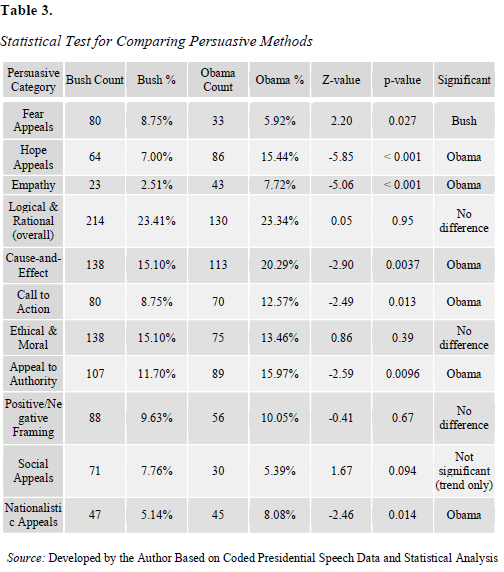
Although the study mainly uses qualitative content analysis, descriptive percentages were compared between the two presidents to identify broader rhetorical patterns. To ensure that the differences in proportions were not caused by random variation or unequal sample sizes, a two-proportion Z-test was used for key persuasive categories for Bush (n = 914 coded units) and Obama (n = 557 coded units). This test checks if one president’s use of a persuasive method is significantly different from the other’s. The Z-tests focused on categories most important to the study’s comparative claims, such as fear appeals, hope appeals, empathy, logical arguments, and calls to action. Statistical significance was set at p < .05. Results confirm that several percentage differences mentioned in the findings represent meaningful divergences rather than sampling effects.
4. Findings: A Comparative Analysis of Persuasive Methods
The multi-phase coding process created a comprehensive dataset for both Presidents Bush and Obama and made the study able to conduct a detailed quantitative comparative analysis of their persuasive methods. The following section presents a quantitative overview of the findings, followed by a qualitative examination of the most frequently used methods, linking them to their strategic purpose (Subject of Persuasion) as identified by the Action–Motivation Model.
4. 1. Quantitative Overview: Comparison of Frequency and Use of Persuasive Strategies
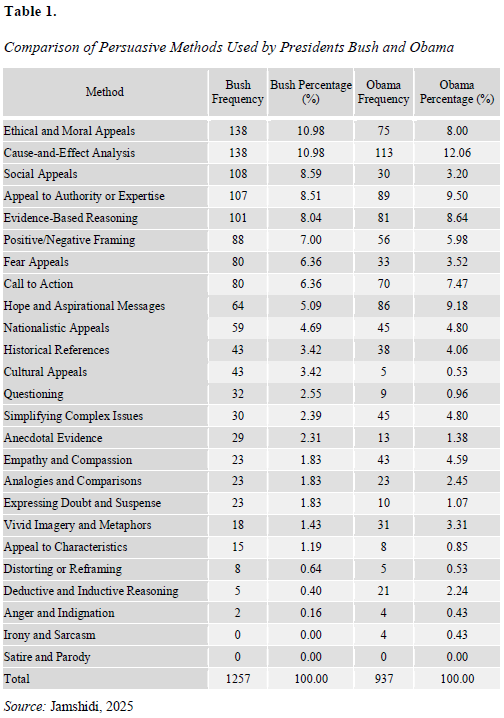
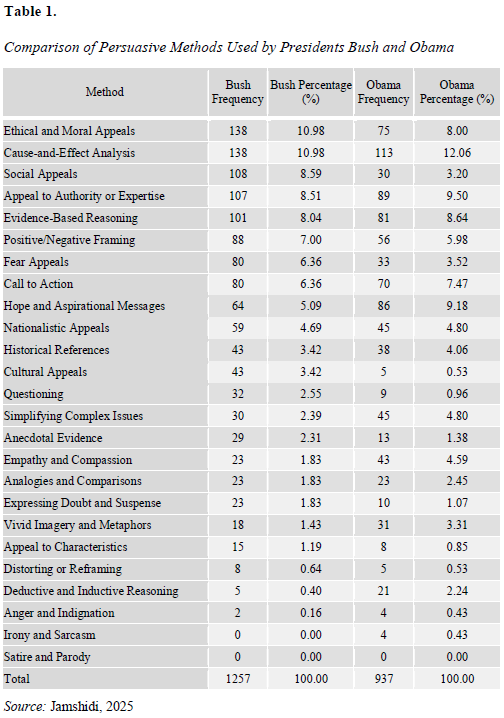
The data in the table 1 show the rhetorical profiles of each president. While both leaders relied heavily on logical and moral appeals, their secondary focuses differed significantly, reflecting their unique political contexts and leadership styles. The table provides a quantitative basis for the content analysis, illustrating statistical trends that support the study’s conclusions.
4. 2. President Bush's Persuasive Methods
The analysis of President Bush’s speeches on Iraq and WMDs revealed a persuasive approach based on Logical and Rational Arguments (214 instances) and Credibility and Moral Appeals (194 instances), supported by a strong use of Emotional Appeals (139 instances). This combination reflects a strategy aimed at justifying decisive, preemptive action by framing it as both a logical necessity and a moral obligation.
4. 2. 1. Logical and Rational Arguments
In this category, Cause-and-Effect Analysis was the most dominant method, used 138 times. Bush often used this technique to justify his actions by linking them to the consequences of Saddam Hussein’s decisions. For instance, he outlined a clear causal chain: the threat from WMDs in the hands of ‘mass murderers’ required the coalition to act and remove these weapons, thus improving security (Bush, 2003b). During a speech, he stated: “By our actions in this war, we serve a great and just cause. Free nations will not sit and wait, leaving enemies free to plot another September the 11th—this time perhaps with chemical, biological, or nuclear terror” (Bush, 2003b). He used this method most often to justify his actions (79 times) and to explain his adversary's actions (30 times) and intentions (21 times), underscoring a pattern of framing his policies as reactive and necessary responses to a dangerous threat. Evidence-Based Reasoning was also a cornerstone, with 101 instances, often referencing authoritative bodies like the UN or the CIA to lend credibility to his claims about WMDs, even when the intelligence was uncertain.
4. 2. 2. Emotional Appeals
Bush’s rhetoric was heavily punctuated by Fear Appeals, used 80 times. He frequently employed emotionally charged language to create a sense of urgency, invoking catastrophic outcomes to motivate public support for military intervention. For instance, he warned: “The attacks of September 11, 2001, showed what the enemies of America did with four airplanes. We will not wait to see what terrorists or terror states could do with weapons of mass destruction” (Bush, 2003a). These appeals were crucial for transforming ambiguous intelligence into a visceral, immediate threat that demanded action. He also used Hope and Aspirational Messages 64 times, often framing the war as a means to ‘bring peace’ to the region.
4. 2. 3. Credibility and Moral Appeals
Bush’s speeches contained a high frequency of Ethical and Moral Appeals (138 instances), second only to cause-and-effect analysis. He consistently framed U.S. intervention as a ‘moral obligation’ to free the oppressed people of Iraq. He stated that “We must stand up for our security and the demands of human dignity. By heritage and choice, the United States will make that stand. The world community must do so as well” (Bush, 2002). This rhetorical choice was crucial in framing the conflict as a binary of ‘good versus evil’. He also used Appeal to Authority or Expertise 107 times, often citing the UN and the CIA to legitimize his claims about WMDs.
4. 2. 4. Action–Motivation Model Findings for Bush
The analysis showed that Bush’s rhetoric was strategically unbalanced. He mainly focused on his own actions and the enemy's intentions. His speeches contained 162 mentions of his own actions compared to only 40 mentions of the subject's (Saddam's actions). On the other hand, he discussed the subject's intentions 43 times, versus just 10 for his own. This strategic imbalance justified preemptive action by casting the U.S. as a proactive and decisive actor, while simultaneously demonizing the adversary's motives as inherently hostile and deceptive.
4.3. President Obama's Persuasive Methods
The analysis of President Obama's speeches on technological intelligence, such as surveillance and drone warfare, revealed a persuasive model that, while grounded in Logical and Rational Arguments (130 instances), prioritized Emotional Appeals (109 instances) and Credibility and Moral Appeals (108 instances) in distinct ways. Obama's strategy was to establish institutional trust and consensus for a more restrained, legally grounded approach to diffuse complex and diffuse threats.
4. 3. 1. Logical and Rational Arguments
Obama's most-used method was Cause-and-Effect Analysis, with 113 instances. However, unlike Bush, he used this approach not to justify preemptive war, but to explain the complex connections between technology, globalization, and new vulnerabilities such as cyber threats. This served as a tool for education and building consensus rather than for mobilizing immediate action on issues like technological threats. For instance, he connected the enhancement of surveillance capabilities to the goal of ‘strengthening’ and ‘enhancing’ global stability (Obama, 2013). Evidence-Based Reasoning was also a key component, with 81 instances, often citing intelligence reports and data to support his claims about new threats.
4. 3. 2. Emotional Appeals
In contrast to Bush's reliance on fear, Obama's rhetoric prioritized Hope and Aspirational Messages, used 86 times. He consistently sought to inspire confidence and motivate audiences toward desirable outcomes, such as a secure, cooperative future. He framed the U.S.'s role not only as a protector, but as a global partner in building a better world. He also used Empathy and Compassion 43 times, a method that was used by Bush only 23 times. This was instrumental in humanizing the impact of policies like drone strikes and addressing concerns over civilian casualties or cases related to surveillance of the US allies.
4. 3. 3. Credibility and Moral Appeals
Obama’s speeches showed a tendency on Appeal to Authority or Expertise (89 instances) and Ethical and Moral Appeals (75 instances). This focus on ethos was a deliberate strategy to build institutional trust and legitimize controversial programs by citing legal bodies such as the FISA court and intelligence professionals. He embedded a narrative of transparency and accountability in his rhetoric, presenting his administration's actions as consistent with democratic values and the rule of law. He would appeal to authority to justify controversial decisions by linking them to legal frameworks and expert opinions, strengthening his persuasive appeals by associating his actions with his position as president and with shared national responsibilities.
4. 3. 4. Action–Motivation Model Findings for Obama
The analysis showed that Obama's rhetoric focused on his own actions and intentions, with a ratio of 95:8 for actions and 24:1 for intentions. This reflects a strategic choice to justify complex, technologically driven policies by emphasizing transparency, legality, and responsibility. Instead of demonizing adversaries, his rhetoric promoted an approach rooted in law and alliances, which was necessary for his new intelligence challenges.
4. 4. Comparison
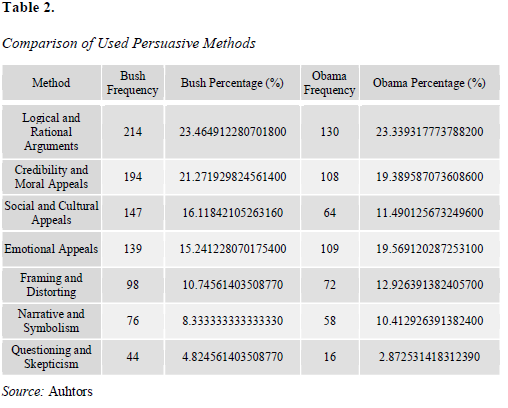
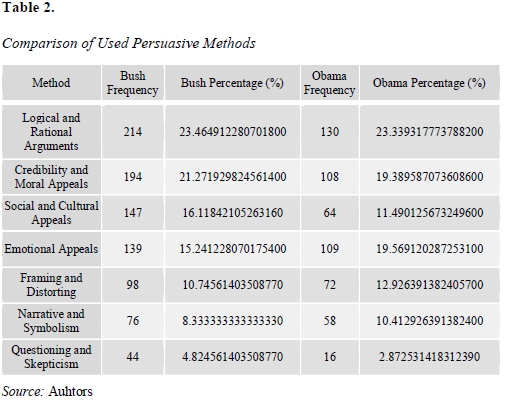
In this section, both models are compared to identify the similarities and differences in the persuasive methods they used. Analyzing the percentages of persuasive methods used by Presidents Bush and Obama can reveal both commonalities and differences in their rhetorical strategies. By normalizing the data into percentages, we can compare how each president emphasized different techniques relative to his overall persuasive strategies. Table 2 summarizes the percentage distribution of the major persuasive categories used by Presidents Bush and Obama.
4. 4. 1. Similarities in Method
Logical and Rational Arguments: This approach is prominent for both presidents, making up 23.5% of Bush’s methods and 23.3% for Obama. The nearly identical percentages reflect a shared reliance on logical reasoning and structured argumentation as the backbone of their rhetoric.
Credibility and Moral Appeals: This method also ranks highly for both, with Bush using it in 21.3% of his discourses and Obama in 19.4%. These percentages reflect both leaders' focus on building trust and aligning with moral principles, highlighting their shared commitment to ethos in persuasion.
4. 4. 2. Differences in Method
Social and Cultural Appeals: Bush allocated 16.1% of his rhetorical strategies to this method, compared to Obama’s 11.5%. This indicates that Bush prioritized aligning with societal norms and shared values more, likely aiming to resonate more frequently with culturally grounded arguments, compared to Obama.
Emotional Appeals: Obama utilized emotional appeals in 19.6% of his methods, slightly higher than Bush’s 15.2%. This indicates that Obama placed greater emphasis on engaging his audience’s emotions than Bush, who relied more on logic and credibility.
4. 4. 3. Mid-Tier Methods
Framing and Distorting: Both presidents used this method with similar emphasis, accounting for 10.7% of Bush’s methods and 12.9% of Obama’s. This indicates a comparable focus on shaping perceptions and framing issues to their advantage, although Obama’s percentage is slightly higher.
Narrative and Symbolism: Bush used this method in 8.3% of his strategies, while Obama used it in 10.4%. This suggests Obama leaned more on storytelling and symbolic language to create resonance and relatability with his audience.
4. 4. 4. Sparingly Used Methods
Questioning and Skepticism: Bush allocated 4.8% of his rhetoric to this technique, significantly more than Obama’s 2.9%. This shows that Bush was more likely to challenge assumptions or encourage critical thinking, while Obama used this method less frequently, perhaps reflecting a preference to affirm ideas rather than question them.
4. 5. Patterns and Overall Comparison
Both presidents prioritize Logical and Rational Arguments as well as Credibility and Moral Appeals, which together account for nearly half of their persuasive methods. This shows a shared rhetorical style based on reason and trust. The main differences are in the ways in which they balance logic, emotion, and cultural resonance. Bush emphasizes societal and cultural ties more, while Obama balances emotional connection with symbolic storytelling. Bush also uses questioning techniques more frequently, indicating a more direct and critical approach in certain contexts.
While the percentages show a common reliance on core methods like Logical Reasoning and Moral Credibility, they also reveal subtle differences in emphasis. Bush’s strategy has a stronger focus on cultural and societal themes, while Obama’s approach combines emotional resonance and storytelling with logic. These patterns reflect their unique rhetorical priorities and styles, shaped by their specific contexts, audiences, and leadership goals. To determine whether the observed differences between Bush and Obama were statistically significant, a two-proportion Z-test was conducted for key persuasive categories. The results are presented in Table 3.
4. 6. Statistical Test for Comparing Persuasive Methods
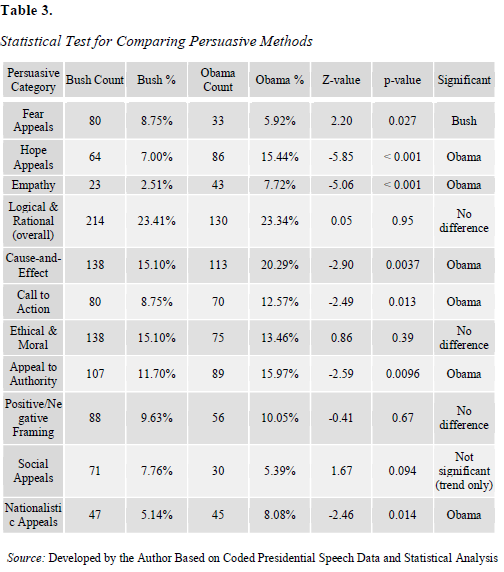
President Bush used fear appeals at a significantly higher rate than President Obama (Z = 2.20, p = .027). In contrast, President Obama relied significantly more on hope appeals (Z = −5.85, p < .001), empathy and compassion (Z = −5.06, p < .001), cause-and-effect reasoning (Z = −2.90, p = .0037), and calls to action (Z = −2.49, p = .013). Obama also used appeals to authority (Z = −2.59, p = .0096) and nationalistic appeals (Z = −2.46, p = .014) more frequently. No statistically significant differences appeared in the use of ethical/moral appeals, positive/negative framing, or overall logical-rational argumentation. These results empirically support the qualitative claim that Bush’s rhetoric relied more on fear-based and morally charged appeals, while Obama’s rhetoric focused more on institutional legitimacy, empathy, and forward-looking optimism.
5. Discussion: Explaining Rhetorical Divergence
The comparative findings reveal that the rhetorical differences between Presidents Bush and Obama were not only a matter of different rhetorical styles, but also a direct and strategic consequence of the distinct national security contexts they faced. The persuasive methods employed by each president reflected their personal leadership styles and were shaped by the challenges their administrations were facing.
5. 1. Bush's Style of Moral Urgency
President Bush’s persuasive style was a direct outcome of his administration’s post-9/11 security context, which depicted the world as a binary conflict between "good versus evil". His rhetoric relied on moral clarity and emotional appeal to justify a significant shift in foreign policy toward preemptive action. His heavy use of Fear Appeals (80 instances) and Ethical and Moral Appeals (138 instances) served to transform uncertain intelligence about WMDs into a moral imperative for preemptive war. This strategy effectively translated abstract threats into a clear, emotionally resonant call to action that mobilized a nation for war.
The Action–Motivation Model highlights this strategic purpose by showing that Bush focused four times more on the enemy's motivation and intention than his own (43 instances vs. 10). This rhetorical focus aimed to demonize the adversary and depict a sense of threat, providing a clear justification for aggressive policies. This approach effectively transformed intelligence uncertainty into a narrative of moral certainty, creating a political environment where decisive action seemed not only reasonable, but also necessary.
5. 2. Obama's Style of Institutional Trust
President Obama's rhetoric, by contrast, aimed to transform uncertainty into shared understanding by highlighting institutional trust and cooperation. His persuasive strategy reflected the complex, technology-driven threats that characterized his presidency. President Obama’s persuasive methods aligned with a fundamentally different strategic context, one that emphasized multilateralism, legal norms, and adaptive resilience in the face of complex, technological threats. His reliance on Cause-and-Effect Analysis (113 instances) and Appeal to Authority or Expertise (89 instances) was a deliberate choice to build public trust and consensus for a more restrained, legally grounded approach to counterterrorism and cyber warfare.
The Action–Motivation Model confirms this strategic focus by showing that Obama focused overwhelmingly on his own actions and intentions (95 mentions of action, 24 of intention), while rarely critiquing his adversaries’ motives. This rhetorical approach was a strategic decision to justify controversial policies, such as drone strikes and surveillance by emphasizing transparency, legality, and institutional accountability. Instead of mobilizing a nation for war, his rhetoric was designed to legitimize a complex, adaptive approach to security by fostering a measured, consensus-based approach grounded in law and alliances, which was required for his new intelligence challenges.
The identified differences in rhetoric could be linked with broader ideas about presidential leadership style in the future by other scholars. Bush’s reliance on fear appeals and moral binaries seems to align with an evangelical leadership style, where the leader’s role is to impose moral clarity upon a chaotic reality. By contrast, Obama’s emphasis on evidence-based reasoning and institutional authority seems to reflect a pragmatic or technocratic leadership style, viewing the president not as a moral arbiter. but as a lead administrator of the rule of law.
Furthermore, the findings demonstrate specifically how persuasion functions as a mechanism to stabilize uncertainty. Uncertainty regarding national security creates political and public anxiety. The analysis shows that Bush stabilized this uncertainty by eliminating ambiguity through the fabrication of moral certainty, replacing ‘we do not know’ with ‘we know they are evil’. Obama stabilized uncertainty by proceduralizing it, replacing ambiguity with a trust in the investigative and legal process. In both cases, the rhetoric serves a stabilizing function, transforming the ‘unknown’ of intelligence into a ‘known’ political narrative that allows the state to function.
6. Conclusion
This article shows that while both President Bush and President Obama relied on persuasive communication to manage uncertainty and justify national security strategies, their rhetorical methods differed greatly. This difference was influenced by the types of threats they faced and the leadership styles they adopted.
The study's contributions are threefold. Theoretically, it refines the understanding of persuasion by introducing a framework of 25 subcategories that expand upon the traditional Aristotelian triad. This framework enables a more detailed analysis of rhetorical choices beyond the simplistic categories of ethos, pathos, and logos. Empirically, the research offers a systematic, data-driven comparison of two presidents across different intelligence contexts, filling a significant gap in existing literature. Finally, the study provides a practical contribution by demonstrating how persuasion functions as a mechanism for stabilizing uncertainty in national security discourse. It highlights that rhetorical choices are not just related to strategy. but actually form part of it.
The analysis of the persuasive methods reveals a clear difference. Bush’s approach transformed intelligence uncertainty into moral urgency, framing threats through a binary lens of "good versus evil" that demanded decisive action. His reliance on fear appeals and moral arguments reflected his post-9/11 security context, which prioritized preemptive military action. Obama's rhetoric, on the other hand, aimed to transform uncertainty into shared understanding, emphasizing institutional trust and cooperation. His reliance on logical reasoning, appeals to authority, and aspirational messages was a strategic choice to build consensus for a more measured, legally-based response to a complex technological threat landscape. When facts are incomplete or contested, it is not intelligence alone, but the story told about that intelligence, that defines national action.
The data show that when intelligence is incomplete, presidential rhetoric serves as a bridge between ambiguity and action. Bush’s ‘moral urgency’ effectively simplifies complex uncertainties into binary choices, using fear and ethical appeals to mobilize preemptive action. In contrast, Obama’s ‘institutional trust’ manages uncertainty by sharing the burden of proof across legal and expert networks, employing logos to justify restraint and targeted engagement.
These findings go beyond historical comparisons; they demonstrate that ‘leadership style’ in security contexts is shaped by a leader handles ambiguity. The study suggests that as intelligence challenges become more technical and diffuse, such as cyber warfare and AI, the ‘moral certainty’ model used by Bush might become less effective than the ‘procedural trust’ model employed by Obama. However, Obama’s reliance on complex legal explanations could risk failing to emotionally connect with the public, as shown by his lower use of fear appeals.
Ultimately, this article shows that persuasion is the main way presidents manage the deep uncertainty of modern intelligence. As the gap between classified information and public knowledge grows, the strength of this rhetorical tool becomes central to democratic accountability.
Authorship Contribution Statement
All authors contributed equally to the conceptualization of the article and writing of the original and subsequent drafts. All authors have seen and approved the final version of the manuscript.
Declaration of the Use of AI and AI Assisted Technologies
This article was not authored by artificial intelligence.
Conflict of Interests and Funding
The authors certify that they have NO affiliations with or involvement in any organization or entity with any financial interest (such as honoraria; educational grants; participation in speakers’ bureaus; membership, employment, consultancies, stock ownership, or other equity interest; and expert testimony or patent-licensing arrangements), or non-financial interest (such as personal or professional relationships, affiliations, knowledge or beliefs affecting authors' objectivity) in the subject matter or materials discussed in this manuscript.
Ethical Considerations Statement
The authors avoided data fabrication, falsification, plagiarism, double publication/submission and any form of misconduct against publication ethics. Authors have properly cited all sources of ideas, words, and materials including pictures, charts, tables and statistics used in their paper.
Data Availability Statement
The dataset generated and analyzed during the current study is available from the corresponding author on reasonable request.
Acknowledgement
The authors would like to thank anonymous reviewers for their comments on the article.
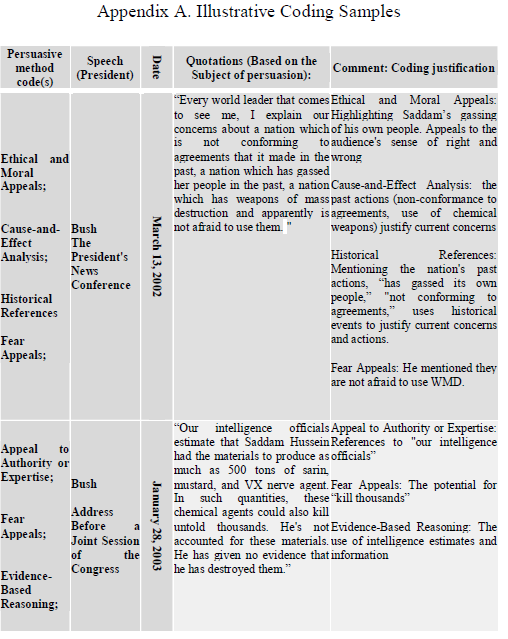
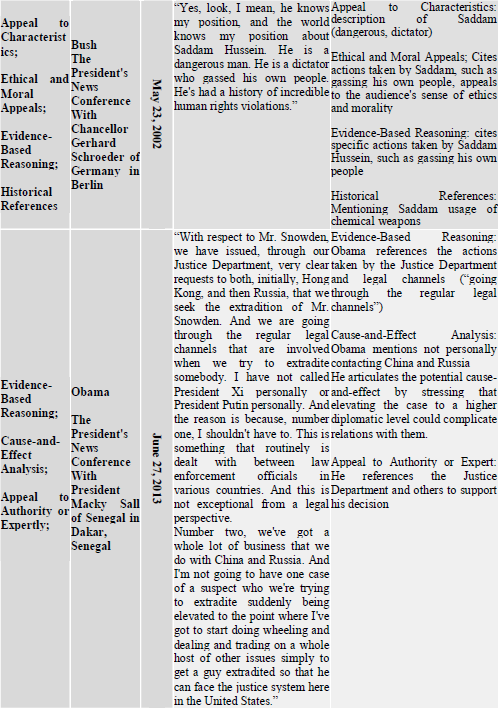
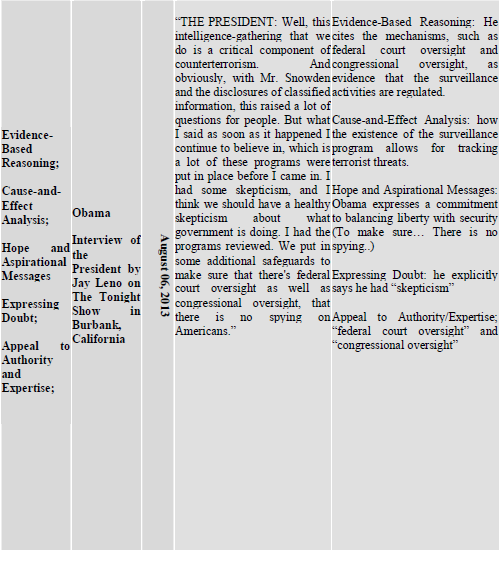
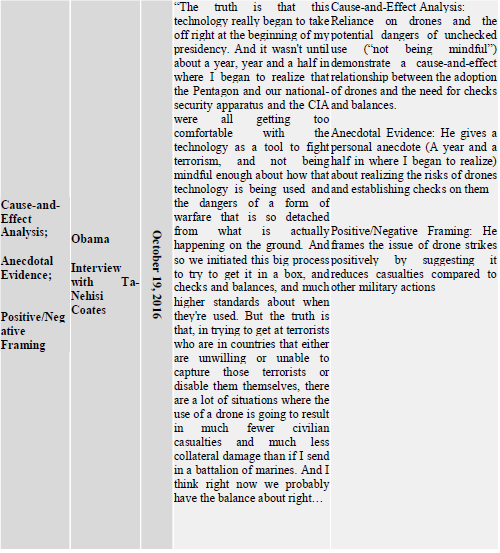
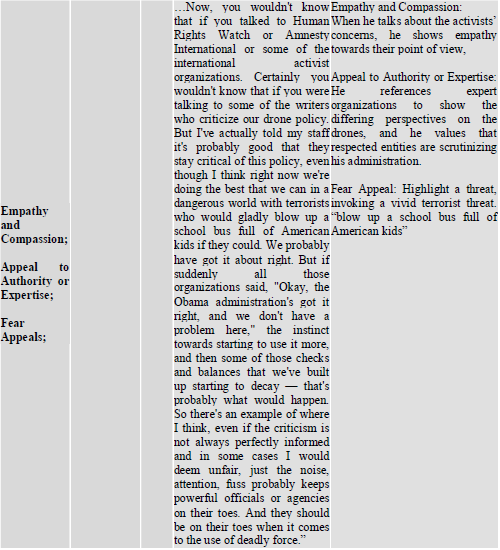
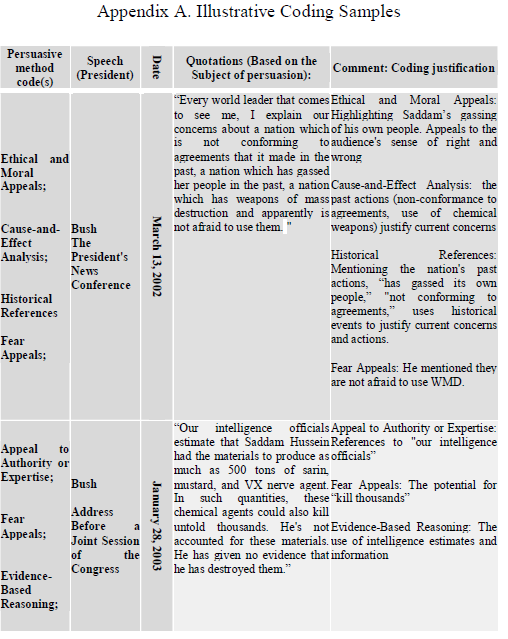
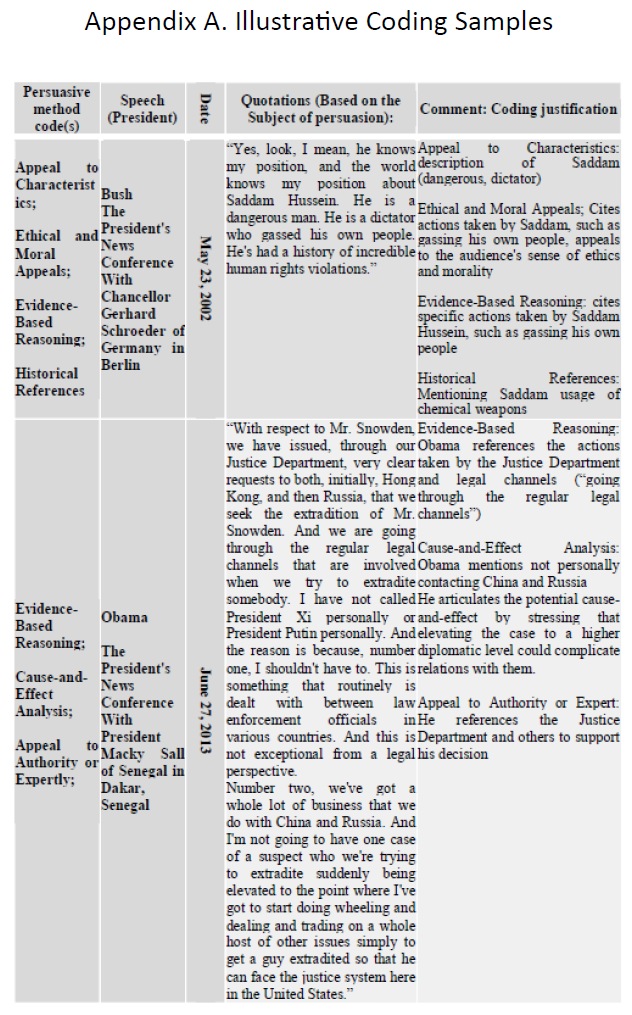
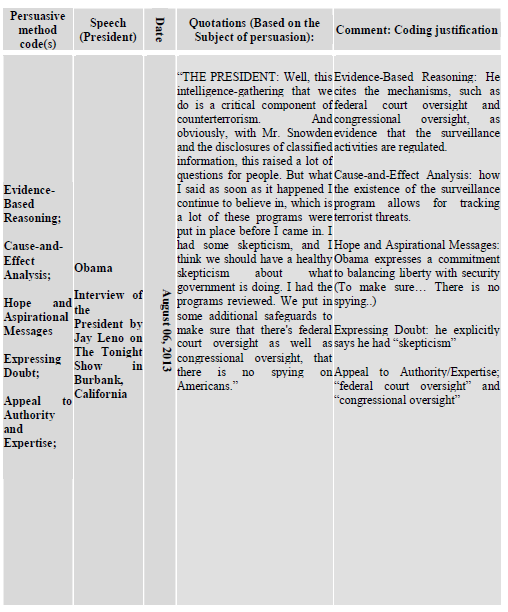
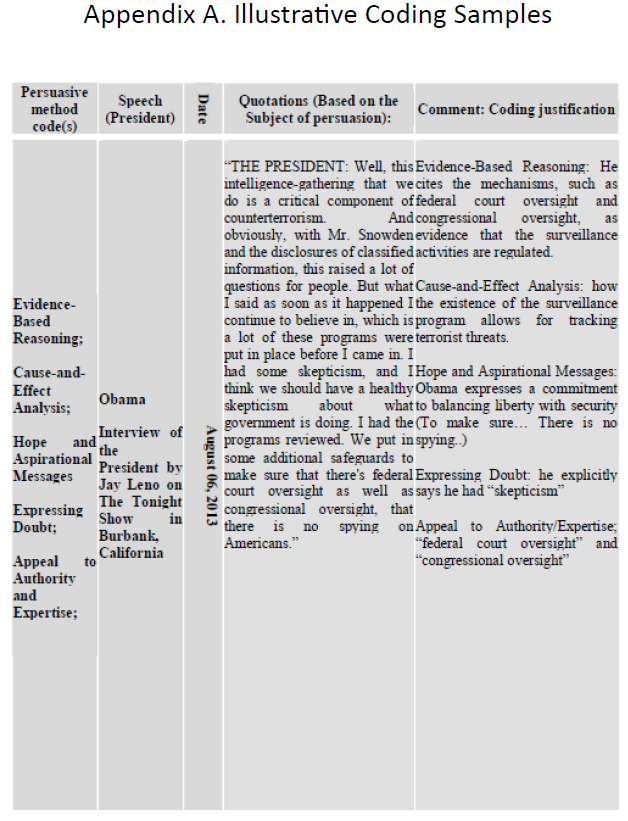
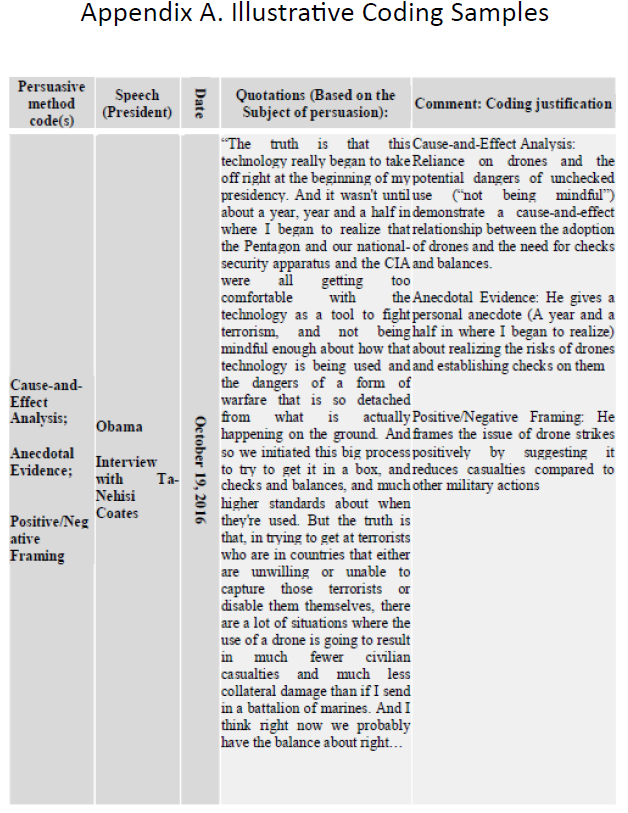
This appendix presents a sample of coded datasets based on 25 persuasive methods to enhance empirical transparency. Each unit of analysis is based on the “object of persuasion” that has been coded based on the Action-Motivation model in the previous stages of coding.

| Article View | 173 |
| PDF Download | 152 |