Scientific Journal
Document Type : Research Paper
Authors
1 Associate Professor of Transregional and Global Studies, University of Tehran, Tehran, Iran
2 MA in North American Studies, University of Tehran, Tehran, Iran
Keywords

This is an open access work published under the terms of the Creative Commons Attribution-ShareAlike 4.0 International License (CC BY-SA 4.0), which allows reusers to distribute, remix, adapt, and build upon the material in any medium or format, so long as attribution is given to the creator. The license allows for commercial use (https://creativecommons.org/ licenses/by-sa/4.0/)
1. Introduction
When Barack Obama took office in January 2009, his administration broke with the coercive unilateralism of its predecessor, adopting a policy of ‘engagement’ and the ‘unclenched fist’. Yet, its approach to the Iranian nuclear program is marked by a historical paradox: the administration that began with the most explicit overtures for dialogue ended by building one of the most comprehensive sanctions regimes ever imposed on a state. Conventional accounts attribute this to US hegemonic power or to the inherent character of Iran's nuclear progress; this paper challenges both. It applies the securitization framework of Buzan and colleagues (Buzan et al., 1998) to trace the way in which Iran's nuclear program was moved from a manageable proliferation concern to an existential threat requiring extraordinary measures. Securitization did not begin under Obama; it had roots as early as the 1990s, although the earlier phases were partial and contested: despite UNSC Resolutions 1696, 1737, and 1747, pre-Obama securitization had weak audience acceptance and limited institutional legitimacy. Obama’s first term represents a qualitatively distinct phase, the institutionalization and multilateralization of securitization, in which the existential-threat narrative achieved broad audience acceptance and juridical codification.
The analysis proceeds chronologically through four phases. In 2009, the rhetoric of engagement, presented as diplomatic outreach, functioned as a securitizing strategy: it shifted the burden of diplomatic failure from Washington to Tehran and, together with Iran's own responses, allowed the Obama administration and its partners to cast Iran as the party refusing normal politics. In 2010, UNSC Resolution 1929 marked the achievement of formal audience acceptance, turning bilateral confrontation into a multilateral consensus. In 2011, the IAEA's ‘Possible Military Dimensions’ report consolidated scientific legitimation, showing how technical expertise was drawn into the securitizing process. In 2012, the campaign reached its peak as extraordinary measures were normalized into routine governance.
Securitization of Iran's nuclear program unfolded in a complex environment, shaped by domestic constraints on both sides. In Washington, the Congress Obama faced was dominated by sanctions hawks and by the influence of advocacy groups, and there were sharp contradictions between legislative initiatives and the administration's preferences. This pressure, together with the dynamics of Iranian agency, meant the administration had to channel hawkish domestic pressure rather than resist it.
In Tehran, the situation was disordered. Following the contested election of June 2009, Mahmoud Ahmadinejad began a second term, and Iran's factions often pursued contradictory policies. Lacking a coherent strategy (or even a clear reading of the securitizing campaign directed against it) the Iranian agency was significantly weakened. The transformation of the nuclear program into a symbol of national sovereignty in the Iranian discourse narrowed the room for maneuver still further. As this paper argues, Iran's own responses were one enabling condition of the campaign's success - not its cause, and not the dominant factor, but a component that securitization studies have consistently under-theorized. The central argument is that US securitization succeeded not primarily through military threats but through a narrative calibrated, in parallel, to several audiences with divergent interests.
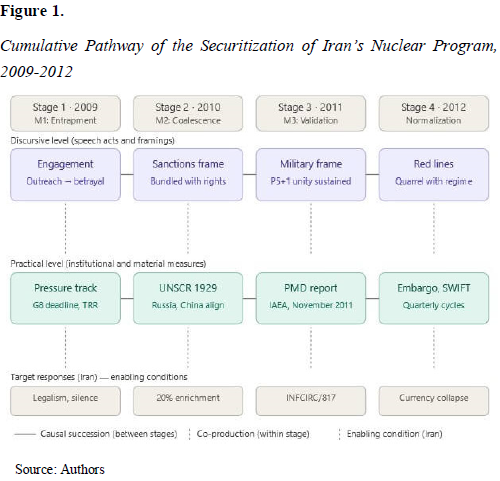
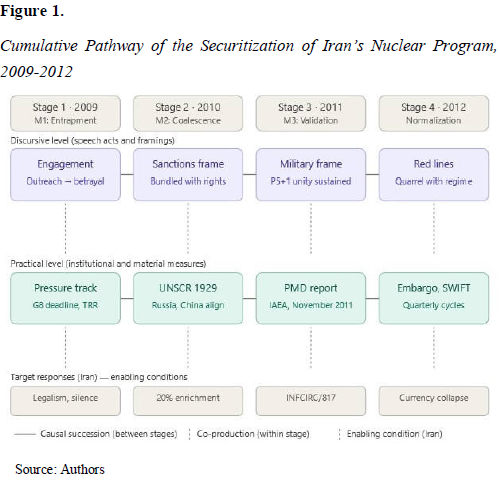
Two analytical commitments distinguish this article from prior treatments of the case. Securitization theory has conventionally concentrated on speech acts and the moment at which audience acceptance crosses a threshold; process tracing has conventionally been applied to material events and decision-making sequences. Obama's first term requires both. The analysis, therefore, treats institutional and material measures - UNSCR 1929, the IAEA's November 2011 report, and the European oil embargo—as integral components of the securitizing process rather than as its consequences, and traces a pathway in which discursive moves and material outputs co-produce one another over four years. This integration is the first of the two theoretical extensions; the second concerns the target agency, theorized here as a structural enabling condition rather than a separate causal factor. Both are operationalized in the Methodology and defended in the Discussion. The analysis uses explanatory-outcome process tracing, with the causal chain summarized in Figure 1.
What Obama's administration achieved, in Schmitt's (2005) terms, was a ‘state of exception.’ Normal diplomacy gave way to emergency management: Iran's nuclear program became a domain in which extraordinary measures were now legitimate. This was accomplished through rhetorical sequencing—extended hand, conditional engagement, betrayal narrative, proof of deception—together with multilateral legitimation and the careful orchestration of allies' harder-line voices to preserve the appearance of reluctant coercion.
2. Literature Review
Scholarly engagement with the securitization of Iran's nuclear program has grown considerably over the past two decades; yet its coverage of Obama's first term as a distinct causal episode remains uneven. Three bodies of work bear directly on this article.
The first are foundational US–Iran securitization studies (Hayes, 2009; Adiong, 2012; Murray, 2014), tracing how identity-based framings did the discursive work that technical proliferation assessments could not. Hayes showed that Washington's divergent responses to the Indian and Iranian programs reflected identity construction rather than capability: India was discursively desecuritized as a fellow democracy, while Iran was constructed as a non-democratic ‘Other’. Even at the height of ‘axis of evil’ rhetoric, he notes, seventy-three percent of Americans preferred economic and diplomatic tools to military action, a finding he attributed partly to securitization fatigue after the 2003 Iraq War. Adiong carried this analysis into the early Obama period, arguing that US and Israeli speech acts worked as mutually reinforcing securitizing moves, and placing Iran's program in the narrow margin between what he calls potential and fictitious threats. Murray connected these dynamics to a longer neo-orientalist genealogy, while noting that even the Bush administration engaged diplomatically when Iran offered concessions, which complicates any straightforward Bush-Obama dichotomy.
The second body of work turns to the Obama administration itself, and these studies converge on a key point: Obama's rhetorical shift away from Bush-era language was not a clean break from securitization. Rubaduka (2017), while framing the Obama period as desecuritization through Hansen's (2012) ‘rearticulation’, finds that Bush and Obama alike treated the prevention of an Iranian nuclear weapon as the top US priority, kept all options on the table, and continued to frame Iran through its alleged illicit activities. Pour-Ahmadi and Mohseni (2012) put the point more strongly, arguing that the administration intensified securitization in response to regional developments in 2011. The most analytically developed account is that of Mohammadyari, Ghasemi Tari, and Sajjadpour (2026). Their qualitative content analysis of 104 presidential texts from 1979 to 2021 finds Obama's first term to be 74.47% securitizing, with ‘Iran's nuclear program is threatening’ as the most frequent code. They read the first-term pattern as a carrot-and-stick strategy in which securitizing and desecuritizing moves ran as paired tracks, and they reserve the term positive securitization for a securitizing discourse that legitimates diplomacy on the argument that even extreme measures would be insufficient. Their data also show that during Obama's second term, desecuritization exceeded securitization, the only such instance in their 1979–2021 dataset.
The third body of work belongs to scholars who directly or indirectly engage with the puzzle of how securitization can succeed without military action. These works belong before the military escalations of 2025 and 2026, but they have some relevance to our work; this puzzle runs directly through the Iran case, and it is taken up by Van Rythoven (2020), Petržilková (2021), and, most directly, Lupovici (2016). Lupovici theorizes the 2009–2012 escalation over Iran's nuclear program, in the Israeli context, as a securitization climax: its function was not to mobilize Israeli public consent for war but to signal to US and Iranian audiences the seriousness of Israel's threat to act unilaterally. Van Rythoven and Petržilková extend the puzzle to the US case, showing how successful securitization at the level of audience acceptance can produce institutional and economic measures without translating into military action. A broader literature situates the securitization of Iran within a multi-actor field. It includes work on Israeli securitization (Ağdemir, 2016; Orossova, 2016; Rajiv, 2016; Soltaninejad, 2022) and Saudi securitization (Mabon, 2018), on alternative paths toward desecuritization (Westermayr, 2015), on the role of think tanks (Fiedler, 2021), on geostrategic competition with China (Pakdel Majd, 2025), and on post-Obama developments (Nawaz & Munir, 2023; Zarif & Afjehi, 2023).
Three gaps motivate this study. First, although several studies characterize Obama's discourse at the level of pattern, none have reconstructed the first term as a single causal pathway through process tracing. The mechanisms by which rhetorical engagement in early 2009 produced institutional consolidation in 2010, scientific legitimation in 2011, and the normalization of sanctions in 2012 have not been examined as a connected sequence. Second, although existing work refers frequently to Iranian behavior, none has systematically theorized target agency as an interactive component of securitization, that is, how the responses, miscalibrations, and silences of the target state functioned as enabling conditions for the securitizing actor's project. Third, the literature has tended to treat speech acts and institutional measures as separate analytical domains. By tracing how engagement discourse, multilateral diplomacy, IAEA reports, and the sanctions architecture co-evolved in mutually reinforcing cycles, this article brings those domains together.
3. Theoretical Framework
Securitization theory was developed by the Copenhagen School of security studies. It defines securitization as “the move that takes politics beyond the established rules of the game and frames the issue either as a special kind of politics or as above politics” (Buzan et al., 1998, p. 23). Its central claim is that security is not an objective condition but an intersubjective practice: an issue becomes a security problem when a securitizing actor labels it as one, and a relevant audience accepts that labeling. Security, in this view, “rests neither with the objects nor with the subjects but among the subjects” (Buzan et al., 1998, p. 31).
Following Buzan, Wæver, and de Wilde's reading of Austin's speech act theory, three conditions facilitate a successful securitizing move (Buzan et al., 1998). First, the speech act must follow the grammar of security, constructing a plot with an existential threat, a point of no return, and a possible way out. Second, the securitizing actor must hold enough social capital to be recognized as a credible voice of security. Third, the threat must resonate with historically familiar referents of danger. The 2009–2012 US campaign satisfies each condition. Presidential and IAEA discourse constructed Iran's nuclear program as an irreversible drift toward weaponization that could be averted only through immediate multilateral action; the Obama administration spoke from the highest position of institutional authority; and the framing drew on longstanding repertoires of proliferation anxiety, Middle East crisis, and the post-Iraq memory of ‘weapons of mass destruction’.
In this case, the primary securitizing actor is the United States, and within it the Obama administration. Other voices, including France, the United Kingdom, Israel, and the IAEA, act as amplifiers and validators within a campaign orchestrated from Washington. The audience is plural and calibrated: the international community, the skeptical P5+1 partners (China and Russia), a sanctions-hawkish domestic Congress, and Iran itself. Audience acceptance is measured here through observable institutional outcomes, namely Security Council votes, major-power alignment, and the absence of effective counter-securitization. This plural-audience structure is itself analytically significant. Critics have long held that the role of the audience is under-conceptualized in the original Copenhagen School framework (Stritzel, 2007; Côté, 2016; Léonard & Kaunert, 2011). The Obama case shows that successful securitization in practice requires the parallel construction of distinct, audience-calibrated narratives, not a single speech act addressed to one unified public.
This paper extends the framework in two further directions. The first concerns the relationship between words and measures. It treats sanctions and institutional measures, such as UNSCR 1929, the IAEA's November 2011 report, and the 2012 oil and financial sanctions architecture, not just as the consequences of a completed securitization but as integral components of the securitizing process itself, in which speech acts and material measures coevolve in a cumulative cycle. The second concerns the target. It theorizes the target agency as an interactive enabling condition: the responses, miscalibrations, legalism, and silences of the Iranian state were not external to the securitization process but functioned as structural facilitators of the securitizing actor's project.
The framework's limits should also be acknowledged. Its focus on the speech act has been criticized for leaving out the bureaucratic practices and physical actions through which security meanings are also communicated (McDonald, 2008), and its reliance on Westphalian and Western political assumptions has been questioned in non-European contexts (Barthwal-Datta, 2009). The empirical extension of this article into the institutional and material dimensions of the campaign, together with its theorizing of target agency, is offered as a partial response to these limits.
4. Methodology
This article uses explanatory-outcome process tracing, which Beach and Pedersen (2013) and Bennett and Checkel (2015) distinguish from the theory-testing and theory-building variants of the method. The distinction matters for what follows. Theory-testing and theory-building ask whether a general theory holds or what such a theory should contain; the explanatory-outcome variant asks why a particular outcome occurred. The outcome examined here is the construction, between 2009 and 2012, of an exceptionally broad multilateral sanctions regime—an outcome reached from a starting point, the declaration of ‘engagement’, that pointed the other way. Other outcomes were available at the outset: continued engagement, a partial agreement, or a crisis deferred to a later administration. Explanatory-outcome process tracing suits this kind of question. It allows mechanisms drawn from securitization theory to be combined with mechanisms from adjacent literatures on institutional legitimation and the production of authoritative knowledge, and it treats minimal sufficiency, rather than parsimony, as the standard by which an explanation is judged.
5. Findings
5.1. Stage 1: Discursive Entrapment (2009)
The year 2009 began with Obama's ‘unclenched fist’ overture (Obama, 2009a) and ended with the revelation of the Fordow facility. Across those twelve months, a series of setbacks in Iranian diplomacy worked to the advantage of the US securitizing campaign and helped recast Tehran from a potential negotiating partner into a constructed threat.
The diplomatic exchanges of early 2009 show the United States working not through overt threat but through a rhetorical trap built around engagement. Many factors already undermined a coherent Iranian response, and in that context, the offers of dialogue were framed so that Iranian rejection became the likely outcome and, with it, the justification for later coercive measures before a global audience. The trap worked partly by design and partly through the miscalculation of its target. On January 26, in an interview with Al Arabiya, Obama said that “if countries like Iran are willing to unclench their fist, they will find an extended hand from us” (Obama, 2009a). The next day, Clinton added that “whether or not that hand becomes less clenched is really up to them” (Clinton, 2009a). From the outset, threat construction was embedded inside the offer of dialogue: in the same interview, Obama folded his overture together with classic securitizing themes: Iran’s alleged “threats against Israel”, its “pursuit of a nuclear weapon”, and its “support for terrorist organizations” (Obama, 2009a). The administration could thus appear diplomatically reasonable, while reinforcing the image of Iran as an inherent danger. The move was calibrated for several audiences at once: to domestic and European publics, it signaled a break with Bush-era unilateralism, and to the wider international community, it cast the United States as a reluctant securitizer, exhausting peaceful options before turning to pressure.
The Iranian response highlighted the efficacy of this trap. At Davos on the CNN panel of February 1, Foreign Minister Manouchehr Mottaki answered not with a direct or positive reply but with a defensive lecture, a pattern that would characterize Iranian diplomacy throughout this period. He told the panel that “the United States needs change because the world has been changed drastically” (Mottaki, 2009), and closed by demanding that “Americans should listen”. Rather than seizing the diplomatic initiative, his response validated the American narrative that Iran had a very “clenched fist”, as the U.S. described it. This perfectly fulfilled the narrative that the trap was designed to create.
Three patterns defined March and April. The first was dual-track messaging. At the Security Council, US Ambassador Rice paired enforcement with engagement, insisting that the sanctions committee had ‘an essential role to play’ even as the United States offered Iran “a new opportunity to increase international confidence in its words and actions” (Rice, 2009). Britain amplified the message in technical language: the UK representative noted that of Iran's 5,500 centrifuges, some 4,000 were enriching uranium ‘for which Iran has no plausible civilian use’ (Sawers, 2009). With this speech act, Sawers transformed enrichment activity into weapons intent through phrasing alone.
The second pattern was P5+1 unity holding firm despite the shift in rhetoric. The April 8 P5+1 statement made clear that Obama's engagement language had not cracked the existing consensus on the so-called Iranian threat; it stressed “shared concerns” and a “commitment to direct diplomacy” (P5+1, 2009). In response, Iran had a highly unfavorable timing: a day later, Tehran announced 7,000 operating centrifuges in a triumphalist framing that undercut Iranian moderates and reinforced the perception of defiance at the very moment flexibility was needed. This so-called ‘nuclear day’ fed directly into Western threat construction.
The third pattern used uncertainty itself as a securitizing device. On April 9, Clinton remarked that “we do not know what to believe about the Iranian program”, citing years of conflicting assessments (Clinton, 2009b). Professed doubt of this kind did real work: it implied concealment and justified verification demands Iran could not meet. What Iran could not disprove became proof of what it was hiding.
Obama's Cairo address of June 4, 2009, added another technique: constructing a threat under the cover of reconciliation. Three dimensions of the speech are worth drawing out.
First, Obama paired an admission of past American wrongdoing, notably that “the United States played a role in the overthrow of a democratically elected Iranian government” (Obama, 2009b), with the claim that “we have reached a decisive point”. The acknowledgment softened the tone; the talk of a decisive point did the securitizing work, presenting current conditions as having made normal politics obsolete.
Second, the speech advanced a regional-cascade argument. Warning that the issue was “about preventing a nuclear arms race in the Middle East that could lead this region and the world down a hugely dangerous path” (Obama, 2009b), Obama lifted Iran's program out of the bilateral frame and made it a matter of regional survival. This move undercut Tehran's attempt to present the dispute as merely an extension of US–Iran tensions.
Third, the speech built a conditional-rights framework. Obama's statement that any nation, Iran included, “should have the right to access peaceful nuclear power if it complies with its responsibilities” (Obama, 2009b) sounded conciliatory but tightened the trap: once rights were tied to responsibilities, any activity outside a strict Western reading became threatening by definition.
Iran was silent following the speech. Obama's Cairo speech offered a face-saving opportunity for engagement. However, Iran's non-response further reinforced Obama’s framing of the Iran-US bilateral as a reasonable America versus an intransigent Iran.
On June 5, an IAEA report set off another securitization cascade, showing how technical data could be turned into an existential threat through coordinated allied amplification. Within forty-eight hours, Israel responded by attacking the institution itself, declaring that the international community “cannot place its trust in IAEA monitoring in Iran”, and tied Iran to North Korea, warning that Tehran was “an attentive student” of Pyongyang's defiance (Israel Ministry of Foreign Affairs, 2009). The framing declared ordinary oversight insufficient and implied an inevitable breakout. A day later, France added technical legitimacy through a burden-of-proof reversal, voicing concern about uranium accumulation “without an identifiable civilian objective” (France Ministry of Foreign Affairs, 2009)—turning the absence of evidence into evidence of intent.
The Security Council meeting of June 15 (which was the first of its kind since Iran's June 12 election) drew these separate efforts together. The US Deputy Representative, DiCarlo, linked the post-election unrest to the nuclear file and then quantified the threat, stating that Iran had produced enough low-enriched uranium for ‘one nuclear weapon’ if enriched further to weapons grade (DiCarlo, 2009). The British delegate presented bare figures: “7,000 centrifuges installed, 1,339 kilograms of low-enriched uranium” as inherently alarming (Parham, 2009). France stressed that the Agency could give no ‘credible assurances’ about undeclared activity in Iran (Ripert, 2009), so that the impossibility of proving a negative again stood in for proof of the positive.
Taken together, these events reveal a securitization cascade. The United States set the base narrative; Israel, as a regional amplifier, raised the urgency; France and the United Kingdom supplied ‘independent’ validation; and the United Nations provided the institutional setting that turned separate national positions into a collective truth. Each actor's claim authorized the others', producing a self-reinforcing dynamic in which counter-securitization became structurally very difficult. Iran's own communication failures, such as defensiveness at Davos, the provocative timing of Nuclear Day, silence after Cairo, let this echo chamber run unopposed.
As of early June, no urgency existed from a technical standpoint; however, urgency was manufactured, and in a temporal securitization, an artificial deadline was established. In the G8 summit press conference, Sarkozy revealed:
President Obama made a gesture… Between August and September, it’s for them to choose what happens. We have made an effort to agree not to strengthen the sanctions immediately in order to get everyone on board, and those who were more reticent on the sanctions pledged to say, ‘OK, Pittsburgh is when the decision will be made (Sarkozy, 2009).
Sanctions, in other words, were deliberately delayed, and the engagement window served not dialogue but consensus-building for a confrontation already anticipated.
Sarkozy also turned contradiction into a weapon. His remark that “it would be so simple if they didn't want the atomic bomb to open up to the inspections” (Sarkozy, 2009) recast Iran's lawful exercise of NPT rights as evidence of weapons intent. Through repetition across actors, treating the refusal of inspections beyond agreed protocols as proof of intent came to be accepted as fact.
The campaign advanced further as Russia (which had previously supported UN Security Council resolutions 1696, 1737, 1747, and 1803) moved closer still to the US position. On August 18, President Medvedev told Israeli President Peres that a nuclear-armed Iran would trigger a regional arms race, ‘a very bad scenario’ (Medvedev, 2009). Coming from a permanent Council member long seen by some as Iran's traditional protector, this was not mere diplomatic courtesy but an endorsement of the broader threat framework.
Iran was absent from the deadline discourse. As the G8 effectively set its timetable, no senior Iranian official challenged the legitimacy of the artificial deadline or offered a counterproposal. Tehran's limited offer of access to Natanz was dismissed as insufficient and read as further bad faith. When ElBaradei, one of the few genuine counter-securitizers, warned on September 1 that “the threat has been hyped”, and that no concrete evidence showed an ongoing weapons program (ElBaradei, 2009), no Iranian voice amplified him. His was the only significant counter-securitizing intervention of the period.
The disclosure of the Fordow facility in September turned abstract threats into what looked like concrete proof of deception. Until then, securitizers had relied on inference and on a risk narrative built around Iranian lack of transparency. Fordow gave them visible evidence that appeared to confirm the narrative. Its timing magnified its effect, arriving after months of engagement rhetoric. In the joint statement of September 25, Obama announced that the United States, the United Kingdom, and France had presented the IAEA with evidence that Iran “has been building a covert uranium enrichment facility near Qom for several years” (Obama et al., 2009). Sarkozy's description of Fordow as built “in direct violation of resolutions” added juridical weight, while Brown's warning that the deception would “shock and anger the whole international community” lent emotional legitimacy to the sanctions now in prospect (Obama et al., 2009).
Obama's October 1 statement confirmed the covert site near Qom and demanded ‘concrete action’ from Iran (Obama, 2009c). The vocabulary of ‘clear evidence’, ‘unfettered access’, and ‘constructive action’ recast diplomacy as the enforcement of obligations. Fordow thus marked the shift from conditional engagement to verification under pressure.
Staged during the UN General Assembly before assembled world leaders, the theatrical joint appearance recast Obama, Brown, and Sarkozy as betrayed peace-seekers compelled to act. It completed what Cairo, the P5+1 declarations, and successive IAEA cycles had prepared: the translation of suspicion into validated threat. For the securitization process, Fordow was the perfect storm. It combined emotional, institutional, and evidentiary components into a single event.
Iran's October 2 response showed the miscalculation. Tehran argued that “Based on the provisions of Code 3.1… Iran has a duty to notify the Agency of its new nuclear facility only 180 days before the injection of nuclear materials” (Iran Ministry of Foreign Affairs, 2009). The argument may have been technically correct, but technical correctness proved irrelevant after being caught building a ‘secret’ facility; the Iranian response demonstrated its persistent failure to understand that securitization operates in the political, not the technical, terrain.
Securitization also operated through humanitarian rhetoric. Obama presented the Tehran Research Reactor deal as a ‘confidence-building step’ (Obama, 2009c). By requiring Iran to ship its low-enriched uranium abroad, the proposal created a no-win choice: acceptance would confirm Western control, rejection would confirm intransigence. A civilian need for medical isotopes had been turned into a test of weapons intent.
The sequence reached a kind of institutional closure on September 29, when UN Secretary-General Ban stated that “They should have informed, notified the IAEA a long time before… when they argue that their nuclear facilities are genuinely for peaceful purposes, the burden of proof is on their side” (Ki-Moon, 2009). The UN's most senior official had accepted the burden-of-proof reversal that marks successful securitization.
By the end of 2009, the securitizing campaign had largely succeeded, and Iranian de-securitization had largely failed. The United States had assembled a set of interlocking narrative elements—the burden-shifting of the unclenched fist, the regional-cascade threat, the humanitarian test—that reinforced one another into a single threat logic. The G8 deadline, Russian alignment, and the carefully timed Fordow revelation showed effective coalition management, while artificial deadlines and controlled disclosure sustained a sense of perpetual crisis that forced Iran into reactive responses. The year illustrates how early framing shapes everything that follows: once a state's credibility has eroded, technical compliance no longer secures de-securitization, and legal argument cannot cut through a political narrative once fear has set in.
The year also makes visible the role of the target agency. Securitization in 2009, and in the years that followed, would have been considerably harder without Iran's own contribution to it. Through silence at critical junctures, defensiveness, and poorly timed announcements, Tehran repeatedly addressed the wrong audiences with the wrong messages - offering legal arguments to the IAEA when political persuasion was needed, and meeting Russian and Chinese concerns with silence. That silence left an interpretive vacuum, which adversaries filled. At the end of the year, Iranian counter-securitization was facing a broad strategic setback as P5+1 achieved unity, the threat narrative was stabilized, Iranian credibility was damaged, and sanction escalation had become inevitable. All of these, plus Iranian defensive legalism, had transformed Obama's extended hand into a clenched fist. The Iranian side, speaking the language of law, found itself answering accusations written in the grammar of fear.
5.2. Stage 2: Institutional Coalescence - The Sanctions Architecture (2010)
The year 2010 witnessed the evolution of Obama’s securitization campaign from an engagement strategy to one of the most comprehensive multilateral sanctions regimes ever imposed on a state. January began with growing momentum for ‘crippling sanctions’, which culminated in the Geneva talks in December. Obama’s second year in office saw the full operationalization of the dual-track strategy, with the pressure track ultimately dominating. The speech acts reveal how the U.S. orchestrated a multilateral sanctions architecture while Iran struggled with defensive responses, ultimately being forced back to negotiations by the year’s end.
The year opened with careful management of Chinese resistance. Asked about US discussions of new sanctions, Chinese Foreign Ministry Spokesperson Jiang Yu insisted that “dialogue and negotiation is the correct way out for the Iranian nuclear issue”, that there was “still room for diplomatic efforts”, and that all parties should adopt “more flexible and pragmatic policies” toward an early resumption of talks (China Ministry of Foreign Affairs, 2010).
The same day, Assistant Secretary Crowley acknowledged the difficulty while holding the line: it was “no secret”, he said, that China and the United States viewed the “utility of sanctions differently”, but “we will continue to work on both tracks” (Crowley, 2010a).
To manage the same Chinese resistance, White House Press Secretary Robert Gibbs was careful to avoid the impression “that we haven't been in discussions with the Chinese, the Russians, and our partners in the P5-plus-1” (Gibbs, 2010). His phrasing revealed an administration technique of ambiguous consensus-building: claiming consultation without confirming agreement, and creating momentum through assertion rather than accord.
Gibbs also set out a timeline, stating that Iran's failure to “act and demonstrate living up to their responsibilities” would “result in consequences” that the administration was already “developing… with our international partners” (Gibbs, 2010).
The killing of an Iranian scientist drew some accusations. Acting Deputy State Department Spokesperson Gordon Duguid called “absurd and false” (Duguid, 2010) without condemning the killing itself.
At the U.S.–Islamic World Forum on February 14, Clinton set out the comprehensive approach. She recalled that the United States had, “for the first time”, joined the P5+1 in meeting Iran at Geneva, and had endorsed, with the other five powers, an offer to fuel the Tehran Research Reactor (Clinton, 2010).
She then linked the nuclear file to human rights, saying that US concerns about Iran's intentions were “intensified by its behavior toward its own people” and that the United States joined others “in condemning these events” (Clinton, 2010). This produced what can be called bundled securitization: two reinforcing threat narratives that are difficult to counter separately.
Iran's Permanent Representative in Vienna, Soltanieh, defended Iran's position at the IAEA Board in INFCIRC/791 (March 2010). On the legitimacy of 20% enrichment, he wrote that the “only new development” since the previous report was Iran's “successful enrichment activity up to 20%” to fuel the Tehran Research Reactor, undertaken after Iran had been “disappointed” by the lack of a “responsible reply” from potential suppliers (Soltanieh, 2010a).
He also attempted a counter-securitizing move, charging that the “root cause” of the dispute was “the hidden agenda of a few Western countries, specifically the United States”, to derail the Agency from its mandate and reduce it to “a UN Watchdog” (Soltanieh, 2010a).
His defense, however, repeated Iran's persistent category error of deploying legal arguments against political narratives. The charge of a ‘hidden agenda’ offered no alternative framing of its own, and the response was again a demonstration of systematic counter-securitization failure.
In INFCIRC/795, the ‘Nuclear Threat Complaint’ of May 17, 2010, Iran raised concerns about US nuclear threats, noting that senior US officials (the President and the Secretaries of State and Defense) had made statements “threatening to use nuclear weapons against some States Parties” to the NPT, Iran among them (Soltanieh, 2010b). The document cited Secretary Gates's remark that the Nuclear Posture Review carried “a very strong message for Iran”, and that “all options are on the table” for states in that category (Soltanieh, 2010b).
June 2010 brought the sanctions climax. On June 1, discussing the Turkey–Brazil initiative, Crowley said the Secretary had reviewed Washington's “outstanding concerns”, concerns “made more compelling” by the latest IAEA report showing Iran “hiding equipment”, failing to cooperate, and continuing enrichment and had judged that Iran “will not move appreciably unless it is subject to additional international pressure” (Crowley, 2010b).
The reasoning behind the U.S rejection was “The statements by Foreign Minister Mottaki, both in New York and also back in Tehran, that the TRR deal, in essence, doesn’t matter. Iran is prepared to continue to enrich” (Crowley, 2010b). On UNSC Resolution 1929, when asked about risking “three no votes, which you’ve never had on a resolution involving Iran before”, his answer, “We are prepared to bring it forward in the next few days”, marked peak coercive confidence as consensus was no longer deemed necessary.
On June 7, the IAEA Director General gave an assessment. While he acknowledged Iran's acceptance of the Tehran-Brazil-Turkey Joint Declaration, “I received a letter from Iran dated 24 May…” (Amano, 2010), however, he immediately reaffirmed the unresolved core, “Iran has not provided the necessary cooperation…” (Amano, 2010). The simultaneous recognition and doubt kept the securitization frame intact.
In June 2010, UNSC Resolution 1929 was adopted by twelve votes to two (Turkey and Brazil against, Lebanon abstaining). It stands as one of the most comprehensive sanctions regimes in the history of the Security Council; its opening paragraphs catalogue fourteen IAEA reports from 2006 to 2010. The resolution's expansion beyond the nuclear file into other sectors, including the conventional military domain, is evidence of total securitization. Paragraph 9's prohibition on ballistic-missile activity exemplifies this: Iran's space program, once framed as legitimate technological advancement, was reinterpreted as the development of weapons-delivery capability. The implementation of Resolution 1929 was among the most damaging episodes in post-revolutionary Iranian history. It marked the beginning of the end of the economic structural barriers to Iran's securitization, since removing Iran from the international economy significantly lowered the economic cost of securitizing it. Our claim will be examined in future research.
The resolution transformed Iran's nuclear program into a case for comprehensive economic isolation, mandating intrusive and anticipatory controls capable of systemic damage to the state's financial and commercial infrastructure. Across its thirty-eight operative paragraphs, it called on states to deny financial services, insurance, and reinsurance to entities linked to proliferation-sensitive activity (para. 21), to bar the opening of new branches and subsidiaries of Iranian banks (para. 23), and to inspect cargo to and from Iran where there were reasonable grounds to suspect prohibited items (para. 14) (United Nations Security Council, 2010).
In December 2010, Catherine Ashton announced that after “nearly two days of detailed substantive talks”, the parties had agreed to continue in Istanbul the following January (Ashton, 2010). German Foreign Minister Westerwelle credited the pressure track, observing that “the united stance of the international community” had “helped open the way for this new start” (Westerwelle, 2010).
5.3. Stage 3: Scientific Validation -The PMD Moment (2011)
The securitization process initiated in 2009 and reached its apex in 2011. This period was marked by Iran’s strategic setbacks and the United States’ effective formation of an international consensus supporting extraordinary measures. The November IAEA report functioned as the “smoking gun”, substantiating years of threat construction. Concurrently, Iran’s persistent resistance and domestic circumstances reinforced the narrative justifying comprehensive international pressure.
The Geneva talks of December 2010 ended in disappointment, although Iran had returned to negotiations after a 14-month break. By early 2011, it was clear that the two sides held fundamentally different positions.
In the first quarter, the P5+1 held together. They presented themselves as open to talks, but set terms that Iran could not meet without a major policy change. Assistant Secretary Crowley's January 7 statement called for “meaningful negotiation” and “tangible steps”, and stressed that the international community would hold Iran accountable until it showed real willingness to “resolve international concerns” (Crowley, 2011).
Meanwhile, Iran’s diplomats focused on deflecting criticism. On February 8, Iran’s Ministry of Foreign Affairs Spokesperson Mehmanparast said “there was nothing left to be discussed about Tehran’s peaceful nuclear program”, and insisted Iran would only talk about “general issues related to nuclear activities in the entire world, specifically nuclear disarmament, Israel’s violation of NPT, and universal peaceful nuclear right” (Iran Ministry of Foreign Affairs, 2011). By shifting the conversation from specific obligations to broader issues, Iran’s approach further supported the Western narrative of threat.
The March 9 IAEA Board meeting consolidated the non-compliance framework as American Ambassador Davies listed the following as Iran’s violations: continued enrichment, withholding information regarding Fordow’s ‘design, construction, and original purpose’, suspended heavy water cooperation, and non-implementation of the Additional Protocol. More critically, Davies emphasized “the increasingly apparent military dimensions” and characterized Iran as “a state with something to hide” that “may still be pursuing… the capability to produce nuclear weapons” (Davies, 2011).
The P5+1 unity statement, delivered by the Russian Governor, called for “prompt implementation and ratification of the Additional Protocol” and noted that the Geneva and Istanbul meetings had produced “no substantive result” (P5+1, 2011). Despite the setbacks, the joint statement showed the coalition holding firm and reinforced the non-compliance framing for later policy.
The April- June phase of 2011 witnessed sanctions expansion and continued defensive documentation. Notable events of this timeline include Iran’s INFCIRC/817 submission, which was received on May 9th (IAEA, 2011a), and its contents reveal a defensive posture. It challenged IAEA legitimacy through procedural complaints, highlighted information security breaches to undermine credibility, argued the illegality of UNSC resolutions on jurisdictional grounds, and cited NPT rights without addressing obligations. The INFCIRC/817 was again too late and legalistic, and it was poorly targeted to address international concerns.
The July-September period of 2011 marked yet another decisive escalation in the securitization campaign and international-level framing of Iran’s nuclear program. The 6607 UNSC meeting on September 7 highlighted a broadening consensus around Iranian non-compliance. The French representative Briens delivered some of the most notable speech acts of this period. He warned that:
…alarming signs are increasing. The Iranian regime is releasing information in small doses to mitigate its impact and significance, but it is no less serious. Thus, in February 2010, Iran began to enrich its uranium to 20 per cent, thus bringing it even closer to the military threshold, supposedly with the sole goal of fueling the Tehran Research Reactor (Briens, 2011).
His statement at the meeting offered a somewhat detailed escalation catalogue, reconstructing Iran’s behavior as a deliberate, cumulative provocation rather than isolated infractions. French representative framed the strategic implication of this facility, describing it as “a bunkerized installation designed for military use … that could be easily and quickly reconfigured so as to produce uranium enriched at a rate higher than 20%” (Briens, 2011). More importantly, he highlighted shifting justifications from the Iranian side as evidence of deception. He recalled that Tehran had originally declared the Qom facility intended for 3.5% enrichment, only to later announce its role in producing 20% material. His rhetorical move reframed Iranian technical explanations as post hoc rationalizations, thus reinforcing doubts around the stated peaceful intent. One of the culmination points of his speech act was a legitimacy challenge: Given the guarantee for Tehran research reactor fuel, “why is Iran continuing to produce 20% uranium?” (Briens, 2011).
At the 6607 UNSC meeting, Wittig, the German representative, echoed the IAEA's unease (IAEA, 2011b); he cited the Agency’s “increasing concerns” and its inability to clarify allegations related to “undisclosed nuclear-related organizations” (Wittig, 2011). His speech act was significant in that it explicitly linked unresolved safeguard issues to military institutions; with this framing, he further eroded the Iranian narrative of civilian use, which was critical to advancing the securitization process. Wittig also highlighted Iran’s launch of the Rassad-1 satellite as “a clear violation of paragraph 9 of resolution 1929” (Wittig, 2011).
Although numerous delegations intervened at the 6607 UNSC meeting, it was the French and German speech acts that substantively advanced the securitization process. This meeting revealed no substantive opposition to the threat narrative. Although China, Russia, and Brazil urged restrained and renewed dialogue, no one challenged the IAEA's credibility or disputed documented violations on the Iranian side; needless to say, no one rejected the sanctions framework. At this stage of the securitization campaign, dissent was procedural rather than normative; in the best case for Iran, this would have led to a moderation of pace, not direction.
At this time, the focus of the securitization campaign was increasingly shifting from diplomatic signaling to evident clarification. This transition was neither abrupt nor unexpected. Rather, it reflected an institutional process already underway within the IAEA. The IAEA November 8 report reads:
The Director General, in his opening remarks to the Board of Governors on 12 September 2011, stated that in the near future he hoped to set out in greater detail the basis for the Agency’s concerns so that all Member States would be kept fully informed (IAEA, 2011c, p. 8).
The report gave a credibility assessment of the information, declaring: “The information comes from a wide variety of independent sources, including from a number of Member States, from the Agency’s own efforts, and from information provided by Iran itself” (IAEA, 2011c, p. 8). Central to this report were also the alleged weapons activities,
The information indicates that Iran has carried out the following activities that are relevant to the development of a nuclear explosive device; efforts, some successful, to procure nuclear-related and dual-use equipment and materials by military-related individuals and entities; efforts to develop undeclared pathways for the production of nuclear material; The acquisition of nuclear weapons development information and documentation from a clandestine nuclear supply network; and work on the development of an indigenous design of a nuclear weapon, including the testing of components (IAEA, 2011c, p. 8).
The report's timeline claim was the most consequential.
The information indicates that prior to the end of 2003, the above activities took place under a structured programme. There are also indications that some activities relevant to the development of a nuclear explosive device continued after 2003, and that some may still be ongoing (IAEA, 2011c, p. 8).
However, the report did make some clarification on Dual-Use: “While some of the activities identified in the Annex have civilian as well as military applications, others are specific to nuclear weapons” (IAEA, 2011c, p. 8). “Since August 2008, Iran has not engaged with the Agency in any substantive way on this matter” (IAEA, 2011c, p. 9).
5. 4. Stage 4: Normalization of the State of Exception (2012)
The opening weeks of 2012 saw further escalation in the securitization of Iran's nuclear program. Western powers had already transformed years of diplomatic frustration into economic warfare. On January 10th, Italy’s Foreign Ministry spokesperson Maurizio Massari declared that Iran’s decision to begin enrichment at Fordow was “cause for deep concern and deserving of the firmest condemnation…. pressure on Iran through tighter sanctions aimed at depriving Tehran of the means to continue nuclear activities that defy international law is inevitable” (Massari, 2012). His assertion was a clear signal that Europe had crossed a psychological threshold, as sanctions were now viewed as strategic imperatives rather than strategic tools.
January 23rd emerged as another coordinated securitizing moment; Cameron, Merkel, and Sarkozy delivered an unusually direct message: “We have no quarrel with the Iranian people. But the Iranian leadership has failed to restore international confidence in the exclusively peaceful nature of its nuclear programme. We will not accept Iran acquiring a nuclear weapon”. (Cameron et al., 2012). This speech act distinguished between the government and the population to maintain moral legitimacy, established an absolute red line, and framed the coming measures as defensive rather than aggressive. When the leaders stated that Iran was “already exporting and threatening violence around its region” (Cameron et al., 2012), they moved securitization beyond the nuclear program (which was already happening) into a comprehensive security narrative.
The European message was immediately reinforced transatlantically. Secretary of State Hillary Clinton and Treasury Secretary Geithner welcomed the EU's oil embargo, Central Bank asset freezes, and financial sector restrictions. The secretaries’ emphasis that these measures were “consistent with steps the U.S. previously has taken” and would “sharpen the choice for Iran’s leaders and increase their cost of defiance” (Clinton & Geithner, 2012) demonstrated the coercive diplomacy strategy in its mature form.
By 2012, speeches were no longer the main way to increase pressure. Instead, detailed rules and official actions took over. EU Regulation 56/2012 turned political decisions into concrete steps, focusing on Iran’s financial system while still allowing some humanitarian aid. Naming Bank Tejarat showed the shift to more focused sanctions and added worries about spreading nuclear technology and avoiding sanctions into rules that made normal business with Iran impossible.
Canada’s announcement of expanded sanctions demonstrated how the securitization campaign had achieved global reach. Foreign Minister John Baird’s statement that Canada had “among the toughest sanctions against Iran in the world” reflected competitive dynamics among allies to demonstrate resolve (Baird, 2012). Throughout these January developments, several patterns emerged that would define 2012’s trajectory. First, the speed of implementation; second, coordination among Western powers; and third, the expansion beyond nuclear issues to include human rights and regional behavior created multiple justifications for pressure that insulated the campaign from accusations of single-issue obsession.
The words used in these announcements showed careful planning. By focusing on Iran’s ‘defiance’ and ‘not following the rules’, they made Iran seem like it was breaking international standards, not just dealing with security problems. Separating ‘the Iranian people’ from ‘the regime’ was meant to keep the moral high ground, even though actions hurt regular people, too. Repeating that “the door remains open” put the blame for the conflict on Iran. Each new rule and statement added to a campaign that had grown from speeches into a complete change in how the world saw Iran. What started as a technical argument about the nuclear program had, through careful words and actions, become a major threat that now justified extreme actions.
By now, the coalition formed as a result of the securitization campaign needed careful calibration to maintain its unity. Secretary of State Clinton's September 14 announcement that eleven European countries and Japan had again qualified for exemptions from U.S. secondary sanctions was an example of such calibration. The certification these nations issued that they had made “significant cuts to Iranian oil revenue” (Clinton, 2012) revealed the quid pro quo underlying sanctions cooperation.
The final quarter of 2012 witnessed the sanctions architecture reaching its zenith of sophistication and impact, as the cumulative effects of years of careful construction manifested in Iran’s deepening economic crisis. The period opened with stark evidence of the pressure’s effectiveness, as Iran’s currency collapsed to historic lows and public protests erupted in Tehran’s bazaars, traditional bastions of government support.
The IAEA Director General’s November 4 address to the UN General Assembly provided crucial technical grounding for the continued pressure campaign. Yukiya Amano’s careful formulation that while “the Agency continues to verify that nuclear material declared by Iran under its Safeguards Agreement is not being diverted from peaceful purposes”, crucially, “Iran is not providing the necessary cooperation to enable us to provide credible assurance about the absence of undeclared nuclear material and activities” highlighted the fundamental issue (Amano, 2012). This distinction between declared and undeclared activities-between what Iran showed and what it might be hiding-provided ongoing justification for maintaining maximum pressure.
Amano’s mention of his November 2011 report about “credible information indicating that Iran had carried out activities relevant to the development of a nuclear explosive device” became a key point for Western diplomats. Using the term “nuclear explosive device” instead of “nuclear weapon” showed technical care while stressing the seriousness of the perceived threat. The September Board of Governors resolution called on Iran to “immediately conclude, and implement, an agreement with the IAEA on a structured approach for resolving outstanding issues related to possible military dimensions”. Stressing “immediately” and mentioning “military dimensions” showed that even usually cautious international groups were using stronger language as Iran’s resistance grew. This support from institutions made Western claims that sanctions were a fair response to non-compliance more convincing.
The technical advancement of sanctions implementation kept progressing and evolved through the Panel of Experts’ work. The panel's capacity to perform on-site inspections, with the cooperation of member states (United Nations Security Council Panel of Experts on Iran, 2012), showed that sanctions enforcement had shifted from political statements to serious, professional investigations. The institutionalization of emergency governance was further evident in the routinized renewal of monitoring mechanisms. Resolutions 1984 (2011) and 2049 (2012) extended the Panel of Experts without substantive debate, demonstrating that the exceptional measures established in Resolution 1929 had become a normalized bureaucratic practice.
Extraordinary measures had long become normalized by the final quarter of 2012. Quarterly IAEA reporting cycles, automatic designation updates, and compliance audits no longer debated whether Iran constituted a security challenge; that premise was assumed. What remained was management. This routinization raised the cost of policy reversal, as sanctions enforcement became intertwined with legal requirements, financial compliance structures, and institutional habits. However, all of these successes are not equal to the success of the securitization campaign. The cumulative effect of 2012 shows a paradox. By now, securitization had achieved unprecedented technical sophistication and reach, and critically, the Obama administration had successfully maintained pressure and coalition coherence (something that neither Bush nor Trump were capable of). Despite all of these tactical successes, the campaign also constrained diplomatic flexibility, and at the same time, Iran’s nuclear activities continued and accelerated; its regional policy remained unchanged. By year’s end, the securitization of Iran’s nuclear program was effectively locked in, not as a temporary response to crisis, but as a durable system of emergency governance.
5. 5. Analytical Synthesis
We trace three mechanisms. They are sequential rather than parallel: each mechanism produces the political conditions under which the next can operate. The success of Mechanism 1 allowed Mechanism 2 to proceed without fracturing the P5+1 coalition; Mechanism 2 supplied the institutional backing the IAEA required to issue the report central to Mechanism 3; and the three together produced the outcome examined in Stage 4. Each is specified below by its entities, its central activity, and its outcome, the form of causal-mechanism specification that Beach and Pedersen recommend.
Mechanism 1: discursive entrapment and burden-shifting: The entities are the speech-act-makers of the United States executive branch (the President, the Secretary of State, and the UN Ambassador) together with allied amplifiers in London, Paris, and Tel Aviv. Their central activity is the issuing of offers of dialogue on terms that make Iranian rejection or delay structurally probable: compressed timelines, informational demands weighted against Tehran, and criteria of good faith fixed in advance. The outcome is a discursive field in which any Iranian rejection, delay, or counter-demand can be read by a plural audience as a refusal of normal politics, which shifts the burden of diplomatic failure from Washington to Tehran. Were this mechanism not operating, Iranian rejection would not produce audience alignment with the American framing. What we observe instead, by mid-2009, is European publics and the Russian and Chinese governments converging on the US characterization of Iranian intransigence: an outcome this mechanism predicts and a sincere-engagement reading does not.
Mechanism 2: institutional coalescence and legitimation: The entities are the US executive branch, the P5+1 partners (initially divided over the appropriate response), and the procedural machinery of the UN Security Council. The central activity is the conversion of a nationally articulated threat narrative into binding multilateral law, achieved through procedural negotiation, allied threat-amplification, and targeted accommodation of wavering members of the coalition. The outcome is the embedding of the threat designation in binding international law. This transforms a claim led by one state into an institutionally authorized one, and it resets the baseline of what counts as legitimate discourse about the program. Were this mechanism not operating, Russia and China would not have voted for binding Chapter VII measures against a state with which each maintained strategic and commercial ties. What we observe is the affirmative vote of both on UNSCR 1929 in June 2010.
Mechanism 3: scientific authority validation: The entities are the IAEA Director-General, the Agency's technical staff, and the Member States whose intelligence fed the underlying assessment. The central activity is the synthesis of that intelligence into a single authoritative document, framed in the language of credibility and released for political effect. The outcome is a shift in where credible knowledge about the program is seen to originate: no longer with political actors but with an institution widely regarded as neutral. This narrows the room for counter-securitization, since challenging the threat now means disputing technical authority rather than a political claim. Were this mechanism not operating, the same intelligence would have carried significantly weaker political consequences. What we observe is a November 2011 report whose institutional and economic effects exceed what it added, substantively, to assessments already on record - consistent with the mechanism's account of the report's political function.
Across the three mechanisms, the analysis applies six diagnostic tests. The logic is Bayesian: evidence is weighed for its diagnostic value rather than counted as cumulative confirmation (Beach & Pedersen, 2013). Each mechanism is examined through one hoop test, which the explanation must pass, but which does not by itself confirm it, and one smoking-gun test, which strongly confirms the explanation if passed.
For Mechanism 1, the hoop test is that engagement rhetoric precedes coercive escalation in time. The explanation requires this, but precedence alone is not decisive, since the engagement could have been sincere rather than entrapping. The smoking-gun test is Sarkozy's admission at the G8 on July 8, 2009 that sanctions had been “deliberately delayed… to get everyone on board”. That statement confirms the entrapment reading, because it is hard to account for under any interpretation in which the engagement track was genuine.
For Mechanism 2, the hoop test is a formal P5 consensus stated in binding Chapter VII language; passing it is necessary but still consistent with a purely hegemonic-coercion account. The smoking-gun test is Medvedev's alignment with the US framing on August 18, 2009 - ten months before UNSCR 1929 - which is difficult to explain unless Mechanism 1 had already shifted the diplomatic burden.
For Mechanism 3, the hoop test is the IAEA's adoption of credibility language that is consistent with the threat narrative. The smoking-gun test is the openly pre-announced timing of the November 2011 report: the Director-General signaled on September 12, 2011 that he intended “to set out in greater detail the basis for the Agency's concerns”. A pre-announcement of this kind points to political coordination of the report's release, which is hard to explain without the institutional backing that Mechanism 2 produced.
The analysis is also designed to distinguish the three-mechanism account from two rival explanations. The first is a hegemonic-power account, on which the outcome simply reflects US material capacity and the predictability of allied alignment. The second is an inherently dangerous account, on which the outcome reflects the genuine threat posed by Iran's enrichment activities. Both are weighed against the evidence in the Discussion.
The four stages traced here fall into the four calendar years of Obama's first term, and it is worth pausing to explain why. The decisive event of each mechanism happens to sit in a separate year: the Fordow disclosure in September 2009, UNSCR 1929 in June 2010, the IAEA's PMD report in November 2011, and the European oil embargo and SWIFT disconnection in January 2012. The alignment with the calendar is therefore empirical, not imposed on the material. The mechanisms do overlap at the edges: discursive entrapment is still at work in Clinton's bundled-securitization framing at the U.S.–Islamic World Forum in February 2010; institutional coalescence has an antecedent in Medvedev's August 2009 alignment; scientific validation has preparatory moves during 2010. What defines each year is the mechanism whose peak event falls within it, and each peak event creates the conditions that let the next mechanism operate. The chronological order of the empirical sections thus follows the causal chain rather than the calendar.
Figure 1 summarizes the cumulative pathway. It breaks each of the four stages into a discursive component (the top band) and an institutional or material component (the middle band), which reflects the central analytical point that securitization here is advanced through speech acts and extraordinary measures at the same time. The horizontal arrows carry the succession claim: the output of each stage creates the conditions for the next. The vertical, two-headed arrows carry the co-production claim: within a stage, discursive and material moves reinforced each other rather than running on separate tracks. The lower band records the main Iranian responses at each stage, and the dashed upward arrows mark the claim, developed in the Discussion, that these responses worked as enabling conditions rather than as effective counter-securitization. The figure is an analytical schematic rather than a full event log; the sections that follow trace each link in detail.
The evidence base is a chronologically ordered set of public speech acts and institutional documents from 2009 to 2012. It includes presidential and ministerial statements, State Department press briefings, Security Council meeting records and resolutions, IAEA Director-General reports and communications, Iranian government statements, and declarations by allied governments. These are read as observable traces of securitizing moves, of audience responses, and of institutional decisions. Source selection followed two criteria. The first is analytical relevance: a document had to bear on how Iran's nuclear program was framed as a threat, or on how that framing was received by an audience. The second is chronological completeness: disconfirming evidence - Iranian counter-narratives, Russian and Chinese resistance, dissenting statements by allies - was included alongside confirming evidence, so that the record is not skewed toward what supports the argument.
The design departs from the conventional use of both theory and method. Securitization theory has tended to concentrate on speech acts; process tracing has more often been applied to material events. This article follows a pathway in which speech and action evolve together, and it treats Security Council resolutions, asset freezes, and oil embargoes as components of the securitizing process itself rather than as its after-effects. This is consistent with Balzacq's (2011) practice-oriented turn in securitization studies, and it is the first of the two theoretical extensions taken up in the Discussion.
Two limitations of the design should be acknowledged. The first is the absence of internal US deliberative evidence. Without access to classified archives, private diplomatic correspondence, or records of decision-making, the study cannot observe the intentions behind particular speech acts, nor establish whether the campaign followed a preconceived design. It therefore infers how public moves functioned within the process, and does not claim to show what any actor intended. This is consistent with the inferential logic of explanatory-outcome process tracing, which allows claims about causal mechanisms to rest on publicly observable traces where the temporal sequence matches the posited causal logic. The second limitation concerns the measurement of audience acceptance. The study uses institutional outcomes - votes, resolutions, statements of alignment - as proxies for it. These capture formal acquiescence, but they may not register private dissent or the depth of conviction among elite audiences.
6. Discussion
The empirical analysis reconstructed a causally sequential process through which the framing of Iran's nuclear program shifted, between 2009 and 2012, from one of several proliferation concerns in US foreign policy to an institutionalized existential threat embedded in multilateral law, technical assessment, and economic architecture. This paper develops two theoretical extensions. The first is to treat sanctions and institutional measures as integral to securitization. The conventional reading of the Copenhagen School treats speech acts as the constitutive moment of securitization, and material measures, including sanctions, as the consequences that follow once audience acceptance is secured; securitization is achieved when the threshold of acceptance is crossed, and what comes after is implementation. The 2009–2012 case is difficult to reconcile with this reading. The measures of 2010 (UNSCR 1929; CISADA) and 2012 (the EU oil embargo; the SWIFT disconnection) did not function merely as the implementation of a securitization already completed. They functioned as constitutive elements of an ongoing process in which each new measure reinforced the threat narrative that authorized the next.
UNSCR 1929 is the paradigm case. Read as implementation, it is the consequence of audience acceptance secured through prior speech acts. However, the resolution's effect on the discursive field was itself constitutive: by inscribing the threat designation in binding international law with the support of Russia and China, it transformed a US-led claim into an institutionally authorized one, and reset the baseline of legitimate discourse about the program. After 1929, dissenting positions had to be argued against the weight of a Security Council resolution, not against the position of a single government. The same applies to the November 2011 IAEA report: its content was technical, but its function was discursive. It transferred the production of "credible" knowledge about the program from political actors to a body widely recognized as politically neutral, and so narrowed the space for counter-securitization, reducing it to a dispute with technical authority rather than a political claim.
The theoretical implication is that securitization, in cases of this scale and duration, is best modeled not as a punctual achievement (speech act, audience acceptance, measures), but as a cumulative cycle in which discursive and material moves co-produce one another over time. This is consistent with Balzacq's (2011) practice-oriented turn in securitization studies, in which heuristic artefacts and institutional practices are treated as integral to the construction of threat rather than as its by-products. The Obama case offers a clear empirical demonstration and suggests that the Copenhagen framework's neglect of material measures has obscured part of what securitization actually does.
The 2009–2012 outcome involved multiple contributing factors. The institutional infrastructure inherited from the Bush administration—successive Security Council resolutions, the P5+1 negotiating framework, and an established sanctions architecture—provided the platform on which the Obama campaign built. Congressional pressure and domestic lobbying, particularly through CISADA in 2010 and the 2011 National Defense Authorization Act, formed an independent legislative track that interacted with executive-branch securitization (Mabon, 2018). Israeli securitizing activity, especially the securitization climax theorized by Lupovici (2016), generated regional pressure for harder US measures and kept the threat of unilateral action a standing condition of US diplomacy. Russian and Chinese strategic recalculations in 2009–2010 enabled the institutional coalescence of the 2010 phase. The IAEA's institutional autonomy, although constrained by political pressure, was not reducible to it. Moreover, material developments in Iran's enrichment program, particularly the Fordow disclosure of 2009, provided the factual substrate on which the discursive moves operated. Each of these factors has been substantially treated in the existing literature. What that literature has not provided is a systematic account of how the target state's responses functioned within the process—the gap that this article's second theoretical extension addresses.
Our claim is that the responses, miscalibrations, and silences of the target state functioned as a structural enabling condition for the US securitizing campaign. This is stronger than the trivial observation that target states sometimes act in ways that make securitization easier: the claim is that target responses are constitutive of the field within which securitization operates, in ways the Copenhagen framework has consistently treated as exogenous. That inattention is partly a consequence of the framework's origins in cases—domestic threat construction, migration, the early post-Cold War European security agenda—in which the target was either absent or unable to respond. Long-duration interstate securitizing campaigns, where the target is itself a sovereign state with diplomatic instruments, foreign-policy discourse, and international-organization membership, require a different analytical posture. The target must be brought back in, not as an object acted upon but as one of the actors whose moves constitute the process. This article makes that move through Obama's first term, where the conditions for tracing target-actor interactions are unusually clear.
This claim can be misread in two ways, and both should be set aside. It is not a claim that Iran was responsible for the outcome: the securitizing actor remains the United States, and the campaign may have proceeded in recognizable form whether or not Iran had behaved as it did. Nor is it a claim that target responses were the dominant causal factor; as the preceding paragraph established, the outcome was the product of multiple interacting factors. The claim is narrower—that among those factors, target responses are the most under-theorized in securitization studies, and the Obama first term is the case in which their structural significance is most visible. Pour-Ahmadi and Mohseni (2012) include a brief section on Iranian response, but treat it as defensive activity outside their analytical scope; Mohammadyari, Ghasemi Tari, and Sajjadpour (2026) code Iranian-directed desecuritizing moves on the US side but do not theorize the target's own responses. Even in works that explicitly engage counter-securitization (such as Hansen, 2012), the structural significance of target responses to ongoing securitizing processes, including, importantly, cases where the target does not engage in effective counter-securitization, has not been systematically developed.
Three specific Iranian patterns illustrate the point. First, framing the nuclear program as a question of legal rights under the Non-Proliferation Treaty, rather than as a political question requiring sustained strategic communication, gave the United States ample material to portray Iran as legalistic and recalcitrant; it also conceded the terrain of legitimacy to the institutional bodies (the IAEA and the UN Security Council) that subsequently produced authoritative knowledge against Iran. Second, the absence of a sustained Iranian counter-securitizing effort aimed at audiences beyond its own domestic public meant that the US-led narrative met no organized competing narrative in international fora; this is the silence to which the analysis refers, and it is significant precisely because effective counter-securitization was within Iran's institutional reach, but was not attempted. Third, the timing of Iranian announcements about enrichment progress—particularly the Fordow disclosure of late 2009 and the higher-enrichment activity of early 2010 intersected with the campaign in ways that retrospectively appeared to confirm US framings; whether or not these announcements were strategically miscalibrated, they were available for the United States to fold into the threat narrative.
By framing target agency as a structural enabling condition rather than a contribution to shared responsibility, the analysis preserves the asymmetry between securitizing actor and target. The United States is the securitizing actor; Iran is the target. But the target's responses are part of the structural context in which the securitizing actor's project takes shape, and ignoring them leaves part of the explanatory work undone. The move is analogous to the one made in the counter-securitization literature; the contribution here is to extend that recognition to a case where the target did not engage in effective counter-securitization, and to argue that this absence is itself significant. On this reading, Obama's first term is not merely a case in which the target agency mattered, but the case that shows what theorizing target agency does for securitization analysis more broadly.
Two principal alternatives merit explicit evaluation. The first is the hegemonic-power account, on which the 2009–2012 outcome reflects US material capacity and the predictability of allied alignment rather than any discursive or institutional process. This explanation is parsimonious, but cannot account for the timing of the outcome. Russian and Chinese alignment in 2010 followed US discursive moves rather than coinciding with them; on a hegemonic-power account, the variation in Moscow's and Beijing's willingness to support escalating measures across 2009, 2010, and 2012 would be inexplicable, since their material relationship with the United States did not vary correspondingly. Zarif and Afjehi (2023) make the point through process tracing: the Trump administration's 2020 attempt to re-securitize Iran through the same Security Council mechanisms, under conditions of comparable US material capacity, failed to produce comparable institutional coalescence. Hegemonic-power explanations cannot accommodate that variation; the present analysis can. The institutional context of 2020 included Resolution 2231, which had embedded a desecuritization that the 2009–2012 campaign never had to displace.
The second alternative is the inherent-dangerousness account, on which the outcome simply reflects the genuine threat posed by Iran's enrichment activities. This account is undermined by the way credibility around IAEA assessments was politically constructed over time. Earlier statements by the same agency—and by others, including the 2003–2007 US National Intelligence Estimate consensus—that no systematic weaponization effort was underway received markedly different political treatment from the November 2011 report, even though the underlying intelligence did not differ as sharply as the political reception suggested. Technical concerns of comparable substance produced different institutional consequences under different administrations, and that variation requires the political explanation this analysis provides.
These findings are most directly applicable to long-duration securitizing campaigns that involve multiple instruments—diplomatic, institutional, technical, and economic—and multiple audiences with divergent interests. The case is less likely to illuminate episodic securitizations of the kind on which the Copenhagen framework was originally built, where a single speech act produces a discrete extraordinary measure in a compressed time frame. It speaks more readily to cases of similar structure: North Korea after 2006; Russia after 2014, in some respects, although with important institutional disanalogies; perhaps China in certain technology sectors today. The structural features that make the Iran case tractable—a target state with significant institutional engagement but limited counter-securitizing capacity, a securitizing actor able to mobilize multilateral instruments, and a referent object recognized across audiences—are present in some of these cases and absent in others.
The analysis also leaves open questions it cannot answer. The most important concerns intent: whether the dynamics traced here unfolded according to a preconceived design or emerged through the iterative interaction of discursive and institutional moves not coordinated in advance. The publicly observable evidence supports inferences about function but not about intent, and a fuller answer would require archival access not currently available. A related question concerns US domestic political constraints—particularly Congress and organized pro-Israel and Persian Gulf-state advocacy—in shaping the timing and form of specific moves; the present analysis treats these as part of the structural context in which the campaign operated rather than as independent objects of explanation. Both questions are tractable in principle and are productive avenues for further research.
7. Conclusion
This article set out to explain a paradox: how an administration that entered office advocating engagement and diplomatic overture came to preside over the construction of one of the most comprehensive multilateral sanctions regimes ever imposed on a state. The answer offered here is that the outcome was neither an automatic consequence of US material power nor an inevitable response to Iran's nuclear advances. It was a causally sequential process, assembled between 2009 and 2012 through the interaction of discursive, institutional, and technical mechanisms. Each stage was a necessary condition for the next, and the cumulative operation of all four produced an outcome that none of them could have produced alone.
Two theoretical implications follow. The first is that sanctions and institutional measures of this scale are not the aftermath of a completed securitization but constitutive elements of an ongoing securitizing process, one in which discursive and material moves co-produce each other over time. The Copenhagen framework's relative neglect of material measures has obscured part of what securitization does in long-duration cases. The second implication concerns the target. Iranian legalism, the absence of sustained counter-securitization in international fora, and the timing of enrichment-related disclosures all functioned as structural enabling conditions of the campaign. The target agency was not the dominant causal factor in the 2009–2012 outcome, but it is the most under-theorized one in the existing literature, and Obama’s first term is the case that makes its significance most visible.
The broader contribution is to show that securitization, in cases of this scale and duration, succeeds not in a single threshold-crossing moment but through sustained processual interaction. The outcome examined here was neither inevitable nor fully under the control of any single actor. It emerged from a sequence of mutually reinforcing mechanisms which, once consolidated, redefined the boundaries of acceptable politics and made alternatives increasingly hard to sustain. The case bears on the analysis of other long-duration securitizing campaigns (for example, North Korea after 2006, and in some respects Russia after 2014), although the institutional preconditions that made the Iran case tractable are not present in all of them. Two avenues seem most productive for further research: the question of intent, which publicly observable evidence cannot resolve, and the role of US domestic political constraints, particularly Congress and organized regional advocacy, in shaping the timing and form of specific moves.
Authorship Contribution Statement
All authors contributed equally to the conceptualization of the article and writing of the original and subsequent drafts. All authors have seen and approved the final version of the manuscript.
Declaration of the Use of AI and AI Assisted Technologies
This article was not authored by artificial intelligence.
Conflict of Interests and Funding
The authors certify that they have NO affiliations with or involvement in any organization or entity with any financial interest (such as honoraria; educational grants; participation in speakers’ bureaus; membership, employment, consultancies, stock ownership, or other equity interest; and expert testimony or patent-licensing arrangements), or non-financial interest (such as personal or professional relationships, affiliations, knowledge or beliefs affecting authors' objectivity) in the subject matter or materials discussed in this manuscript.
Ethical Considerations Statement
The authors avoided data fabrication, falsification, plagiarism, double publication/submission and any form of misconduct against publication ethics. Authors have properly cited all sources of ideas, words, and materials including pictures, charts, tables and statistics used in their paper.
Data Availability Statement
The dataset generated and analyzed during the current study is available from the corresponding author on reasonable request.
Acknowledgement
The authors would like to thank reviewers for their comments on the article.

| Article View | 237 |
| PDF Download | 104 |