
Scientific Journal
Document Type : Research Paper
Authors
1 Associate Professor of Political Sciences, Ferdowsi University of Mashhad, Mashhad, Iran
2 M.A. in Political Sciences, Ferdowsi University of Mashhad, Mashhad, Iran
Keywords

This is an open access work published under the terms of the Creative Commons Attribution-ShareAlike 4.0 International License (CC BY-SA 4.0), which allows reusers to distribute, remix, adapt, and build upon the material in any medium or format, so long as attribution is given to the creator. The license allows for commercial use (https://creativecommons.org/ licenses/by-sa/4.0/)
1. Introduction
A significant part of the misunderstanding surrounding online political conflicts arises from treating the intensity of conflict as equivalent to the kind of relationship that the text constructs with the political rival. The sharper the language, the more explicit the attacks, and the harsher the labels, the more readily it is assumed that the relationship with the rival has also become more hostile, exclusionary, or driven by hatred. This equivalence may help describe the heated character of the space, but it is not sufficient for analyzing the kind of relationship that the text constructs with the rival. The central question is how the political rival is represented within the conflict, and how far this representation keeps the rival within the bounds of political tolerance (Iyengar et al., 2012, 2019; Druckman & Levendusky, 2019; Finkel et al., 2020).
This question becomes more significant in the context of Persian X. Despite restrictions on access, X remains an important arena for observing, recirculating, and articulating Persian political conflicts. Yet Persian Twitter, or Persian X, cannot be treated as a direct representation of Iranian society as a whole. It is a field in which ordinary users, journalists, media outlets, political activists, and networks close to forces inside and outside the country simultaneously compete over the narration of events, the boundaries of legitimacy, and the position of the rival (Kermani & Adham, 2021; Kermani & Tafreshi, 2023). The factional logic structuring this space extends to conflicts beyond Iran’s borders, where users align themselves along Reformist–Fundamentalist lines (Shahghasemi, 2023). Although this space is not a substitute for the society as a whole, it is an important site for studying various forms of rival representation and the ways in which the relationship with the rival hardens.
The three cases examined in this study are brought together on this basis. The 2024 presidential runoff election provides a setting in which legitimacy, participation, and belonging become salient. The dispute over the enforcement of the Chastity and Hijab Law foregrounds a conflict organized around coercion, interference in everyday life, dignity, and humiliation. The case of whether Iran should negotiate with the United States, in turn, creates a setting in which strategy, compromise, surrender, and loyalty may operate simultaneously. Placing these three cases side by side is not intended as a simple comparison of the intensity of conflict. The comparison shows that, in each case, the relationship with the rival hardens along a different path (Kubin & von Sikorski, 2021; Arora et al., 2022; Matthes et al., 2023).
The central distinction here is between the intensity of conflict and the kind of relationship constructed with the rival. In the study of online political conflicts, harsh language alone does not indicate the extent to which the relationship with the rival has deteriorated. Some intense forms of discourse still remain within the bounds of ordinary boundary-making; some move closer to othering; some proceed through the moralization of conflict; and others, despite considerable conceptual pressure, are still not sufficient to warrant the designation of political hatred. The argument matters beyond the selection of the three cases or the focus on Persian X. Its value lies in separating the intensity of conflict from the relational pattern through which the rival is represented, and in defending a documented and auditable cluster-level reading rather than a hasty reliance on intense single posts.
1. 1. Problem Statement and Research Questions
The literature on affective polarization has rightly shown that the relationship with the political rival cannot be reduced to ideological distance. Yet an important gap remains. A substantial part of this literature registers hostility toward the rival at a general level, but it is less clear about the precise relational forms in which such hostility manifests in the text. This creates a distance between the general measurement of hostility and a relational reading of political conflict.
Research on online conflicts shows a similar gap. In many readings, disagreement over positions, ‘us–them’ boundary-making, othering, moralization of conflict, delegitimation, and political hatred are not sufficiently distinguished from one another. As a result, harsh language, explicit attack, or the frequency of labels is implicitly treated as an indicator of the kind of relationship constructed with the rival (Finkel et al., 2020; Rossini, 2021, 2022; Garrett & Bankert, 2020). Tone alone cannot show where, precisely, the rival is positioned in the text. Two discourses may be close in linguistic intensity, while one remains within ordinary boundary-making and the other moves toward problematizing the rival’s belonging, loyalty, or moral standing.
In Persian X, this problem is accompanied by a methodological ambiguity. Many available examples are intense, label-laden, or exclusionary single posts. Since the data do not in all cases provide complete and comparable interactional sequences, however, a stable relational logic cannot be inferred immediately from every intense example. The issue concerns not only what has been said, but also the level of data at which that statement can be defended: the level of a single post, an interactional-discursive cluster, or the case as a whole. Without a clear level of observation, the analysis either stops at describing intensity or too hastily collapses distinct concepts onto one another (Kubin & von Sikorski, 2021; Rossini, 2021).
The central problem can therefore be formulated as follows: how can documented and traceable interactional-discursive clusters allow a distinction between disagreement over positions, ordinary boundary-making, othering, moralization of conflict, and cases approaching the threshold of political hatred, without allowing conceptual analysis to outpace the empirical evidence?
The main research question is: How is the political rival represented in documented and traceable interactional-discursive clusters across the three cases of the 2024 presidential runoff election, the enforcement of the Chastity and Hijab Law, and the dispute over whether Iran should negotiate with the United States; and through which paths does this representation move beyond disagreement over positions or ordinary boundary-making?
The subsidiary research questions are:
1. To what extent do the differences among the three cases concern differences in the intensity of conflict, and to what extent do they concern differences in the relational logic of rival representation?
2. At what level of observation can these distinctions be defended more adequately?
3. What kind of evidence is sufficient for moving from ordinary boundary-making to othering or the moralization of conflict?
4.Under what conditions should intense examples not be hastily elevated to political hatred?
1. 2. Literature Review and Theoretical Framework
1. 2. 1. From Affective Polarization to the Problem of Rival Representation
The starting point of this study is the distinction between ideological polarization and affective polarization. The former refers to distance in political positions and preferences; the latter concerns liking and disliking, trust and distrust, and tolerance or intolerance toward the political rival (Iyengar et al., 2012, 2019; Druckman & Levendusky, 2019). Comparative literature has also shown that affective polarization in non-American settings, especially in multiparty systems, cannot be understood simply through the classic two-party model (Reiljan, 2020; Wagner, 2021).
For the present problem, however, this literature is sufficient only when the question shifts from ‘the intensity of hostility toward the rival’ to ‘the way the rival is represented in the text’. This is where the study departs from general measurements of hostility: the problem is not limited to the increasing negativity of the relationship with the rival; the main focus is on how the rival is positioned in the text.
1. 2. 2. Ordinary Boundary-Making, Othering, and Delegitimation
No politics takes shape without drawing boundaries between ‘us’ and ‘them’. Yet not every act of boundary-making can be defined as othering. The importance of this distinction lies in the fact that, in the first case, the rival remains a party to political conflict despite sharp disagreement; in the second, the rival is pushed into a position where his/her presence is no longer viewed within the framework of ordinary political competition (Laclau & Mouffe, 2001; Mouffe, 2005, 2013).
Ordinary boundary-making refers to a situation in which actors define themselves as belonging to different camps, hold the other side responsible for division or failure, or guard intra-camp boundaries, while still not expelling the rival from the bounds of political belonging or legitimacy. At the operational level, indicators of this level include attributing division, defending the in-group position, blaming the rival for creating fractures, or attacking the rival’s honesty and political efficacy, without rendering his/her presence fundamentally problematic.
Othering begins when this situation changes. The rival is no longer defined simply as someone with incorrect positions or harmful conduct; rather, his/her belonging, loyalty, and standing as a legitimate participant are called into question (Kinder & Kam, 2010; Mason, 2018; Tajfel & Turner, 1979). At the operational level, this transition is recorded when the text or cluster brings the rival close to the position of an actor with no legitimate standing, an agent of influence, or someone whose relation to collective boundaries, legitimacy, or loyalty has become doubtful. The boundary between ordinary boundary-making and othering, therefore, does not lie in the harshness of tone, but in the kind of position assigned to the rival.
Delegitimation also becomes important in this context. Delegitimation, however, is not treated as an independent coding level; it is understood mainly as an outcome or intermediate link in certain processes. This understanding is consistent with Bar-Tal’s view of delegitimation as a mechanism for expelling the opposing side from acceptable political and social categories (Bar-Tal, 1990). Where the rival’s belonging, loyalty, or moral standing is undermined, delegitimation may be one result. It is not used in this study as a concept parallel to othering and the moralization of conflict.
Discourse-analytic research in this journal has applied the same Laclau–Mouffe apparatus to the representation of the Iranian political identity: Nabavi-Zadeh Namazi et al. (2024) trace how a media text dislocates and delegitimizes the signifiers of a hegemonic discourse, drawing an ‘other-making border’ against those outside it. The present study shares this concern but shifts the site of analysis from an external media text to intra-Iranian interactional discourse across three cases.
1.2.3. The Moralization of Conflict and the Threshold of Political Hatred
Following these distinctions, it is also necessary to distinguish between moral judgment about a policy and the moralization of conflict. Many political disputes contain moral expressions, but this alone does not amount to the moralization of conflict. The moralization of conflict begins when the conflict as a whole, or the rival’s position within it, is represented in the language of justice and injustice, dignity and humiliation, oppression and right, or betrayal and loyalty (Skitka et al., 2005; Garrett & Bankert, 2020; D’Amore et al., 2022).
Identifying this level depends on the dominance of a moral framework of judgment at the cluster level, and is not reduced to the presence of a single moral expression. At the operational level, this dominance is recorded when the central issue no longer concerns only the efficacy or inefficacy of a policy, and when injustice, humiliation, dignity, repression, compromise, or betrayal has become the framework for reading the conflict. For this reason, the moralization of conflict is not equated with the mere presence of value-laden words. The main criterion is the shift in the axis of conflict from disagreement over policy to moral judgment about the nature of the conflict or the rival’s position within it.
The same precision is required in relation to political hatred. One serious risk in studying online conflict is the conceptual inflation of this term. If every insult, every command of exclusion, or every intense formulation of betrayal is immediately called political hatred, no clear boundary remains between sharp disagreement, othering, moralization, and hatred. This study therefore adopts a strict threshold for political hatred. Here, political hatred is invoked only when there is relatively stable evidence of reduced tolerance toward the rival’s very presence as a party to the conflict. For this reason, insult, humiliation, an isolated case of casting the rival as a spy, or an intense framing of betrayal is not sufficient for elevation to political hatred (Rossini, 2021, 2022; Petsko & Kteily, 2024). At the level of coding, this means that even very intense examples are kept only as cases approaching the threshold of political hatred unless they have sufficient cluster-level support and show signs of reduced tolerance toward the rival’s presence.
1. 2. 4. The Theoretical Pillars of the Study
Four theoretical sources serve as pillars in this study, although their functions are not the same. Schmitt recalls the outer limit of the political: the point at which the friend–enemy distinction becomes the final horizon of conflict (Schmitt, 2007). In the present discussion, this source is used in a limiting and descriptive sense; it does not provide a general model for all conflicts. Mouffe, and at a more foundational level Laclau and Mouffe, distinguish between a boundary-making process that still remains within politics and one that approaches the threshold of antagonism (Laclau & Mouffe, 2001; Mouffe, 2005, 2013). Bar-Tal explains how delegitimation is constructed along certain paths (Bar-Tal, 1990). Furthermore, Levinas, in ethical terms, suggests that not every intense form of confrontation should be hastily elevated to a level at which the rival is treated merely as an entity to be excluded (Levinas, 1969).
In Levinas (1969)’s words, the face of the other is not a visual perception, but an ethical claim that precedes political classification and resists the other’s complete reduction to an enemy to be eliminated. This bears directly on the threshold adopted here. Even when a text represents the rival harshly, the rival retains a face that the text does not fully succeed in erasing, and the analyst’s own act of classifying that text is therefore not ethically neutral: to certify a body of discourse as political hatred is to perform an exclusion with consequences, and such an exclusion requires evidence proportionate with what it asserts. On this view, the strict threshold is at once a safeguard against conceptual inflation and an ethical reluctance to declare, on insufficient evidence, that the rival’s standing as a party to the conflict has been withdrawn.
Given these concerns, the study’s theoretical framework offers a criterion for containing conceptual inflation and keeping the analysis in relation to the evidence.
1. 2. 5. The Conceptual Model of the Study
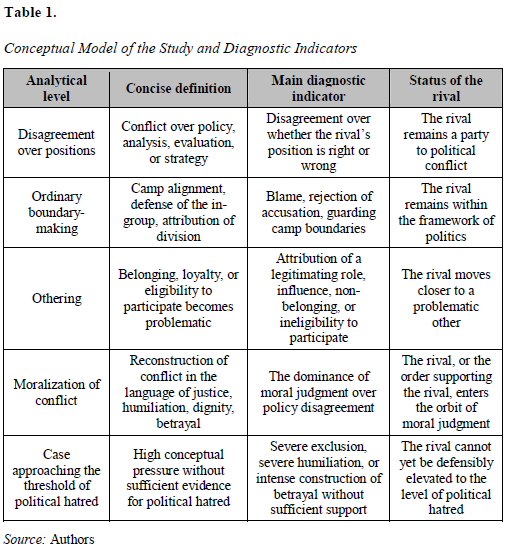
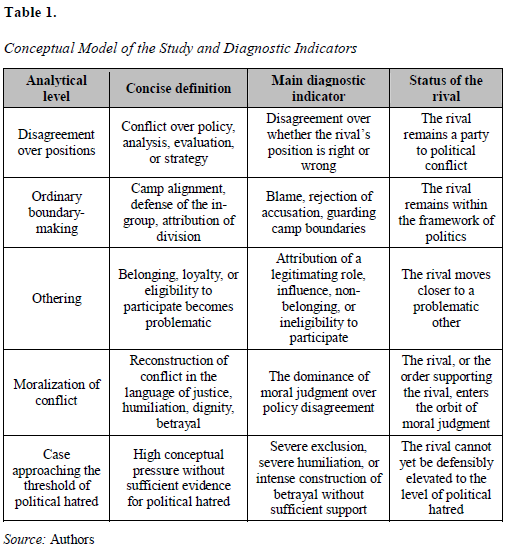
On the basis of this framework, the relationship with the political rival is distinguished in this study across five levels (see Table 1). The first level is disagreement over positions, where conflict still turns on policy, analysis, evaluation of events, or strategic preference. The second level is ordinary boundary-making, where ‘us–them’ alignment, defense of the in-group position, attribution of division, or blame directed at the rival is present, but the rival is still not expelled from the framework of political conflict. The third level is othering, where the rival becomes problematic not only as the holder of an incorrect position, but in terms of belonging, loyalty, legitimacy, or eligibility to participate. The fourth level is the moralization of conflict, where the conflict itself, or the rival’s position within it, is reconstructed in the language of justice and injustice, humiliation and dignity, oppression and right, or betrayal and loyalty. The fifth level is the case approaching the threshold of political hatred, where conceptual pressure is high, but the evidence is still insufficient to warrant the designation of political hatred.
This model clarifies the path of analysis in advance. The model is not used for general or hasty labeling, but as a criterion for drawing boundaries between different levels of reading. No example is elevated to a higher level simply because of the intensity of tone, harsh vocabulary, or the presence of a humiliating expression. What matters is the position that the text or cluster constructs for the rival and the kind of relationship that takes shape through it.
The framework supplies the conceptual vocabulary for interpretation and the basis for analytical decision-making. Theory has an explanatory function, but it also offers a criterion for determining whether an example remains at the level of disagreement over positions, approaches ordinary boundary-making, reaches othering, or should be read as the moralization of conflict. For this reason, the research method is designed in continuity with the theoretical framework.
1. 2. 6. Methodology
The present study is a qualitative, text-centered, processual-comparative study in the field of political discourse analysis. The logic of reading each case follows the sequence of description, explanation, and analysis. This sequence matters in the tradition of critical discourse analysis, as well as for moving from linguistic signs to political logics and then to their relation with hegemony and power (Fairclough, 1992, 1995; Eslami & Danesh, 2022). Here, description concerns the introduction of anchor formulations; explanation links them to political and social fault lines, and analysis specifies the kind of relationship constructed with the political rival.
The three cases were selected on the basis of theoretical variation, not with the aim of statistical representativeness in relation to the online political space. The election case was selected for situations in which legitimacy, participation, loyalty, and the rival’s relation to the boundaries of belonging become salient. The hijab case concerns situations in which conflict is organized through the language of coercion, interference in everyday life, dignity, and humiliation. The negotiation case was selected for situations in which strategic considerations, threat, compromise, surrender, and loyalty may operate simultaneously.
The main unit of assessment in this study is the interactional-discursive cluster. This unit refers to a relatively coherent set, consisting of an initiating post and the texts associated with it, which together construct a particular relationship with the political rival. Here, ‘evidentiary package’ refers to that part of a cluster or family of texts that carries a specific evidentiary burden in the final version of the article. An evidentiary package is therefore not necessarily equivalent to the entire cluster; it refers to the documented, clear, and traceable part of the cluster whose methodological status is also specified in the correspondence table and data file.
Throughout the analysis, the study relies only on clusters and packages, for which the link between the initiating post and its interactional range is sufficiently clear, traceable, and auditable in the data file and correspondence table. The attached Excel file is not only a repository for the data; it also preserves the path of recording, decision-making, and auditability.
At the level of overall design, the study refers to 64 direct posts in 23 final clusters. In the present version, the claim rests only on packages that the final decision sheet identifies as retained and included in the main corpus, with a traceable relation to the cluster and to their analytical role. By contrast, examples that are notable in terms of intensity of expression, irony, or conceptual pressure, but whose status is rejected, borderline, reserve, or awaiting final integration, are not included in the core of the main argument. The logic of evidence selection is therefore not based on intensity of expression, but is organized through theoretical-analytical and auditable sampling.
To guard against the risk that the analysis might highlight only examples that support the initial reading, the study distinguishes among main, differentiating, borderline, and audit samples. Main samples carry the argumentative burden. Differentiating samples show why not every harsh text necessarily leads to a more severe reading of the relationship with the rival. Borderline samples are retained to test the limits of the concepts. Audit samples are kept specifically to clarify why some highly intense forms of discourse are still not sufficient to establish political hatred. This distinction is part of the study’s logic of validation and does not merely describe the archival arrangement of the data.
Coding was conducted at two levels. At the first level, the findings were organized into case-based families and evidentiary packages. At the second level, all items were reread through the study’s common conceptual map. Decisions were not made on the basis of a single word, an insult, or the intensity of tone. The main criterion was the kind of relationship that each item constructs with the political rival at the cluster level. To answer this question, the analysis considered the scope of generalization in the claim, the position assigned to the rival, the rival’s relation to the boundaries of belonging and loyalty, the dominance or non-dominance of a moral framework, and the presence or absence of signs of reduced tolerance toward the rival’s presence.
Given the political sensitivity of the research context, the article mainly uses close but non-identifying paraphrase. Usernames and identifiable details are not reproduced, and each central claim enters the text only when it is connected to clear internal IDs and a specified evidentiary role. This consideration is consistent with existing recommendations in internet research ethics, and with standards of trustworthiness and auditability in qualitative research (Franzke et al., 2020; Lincoln & Guba, 1985; Tracy, 2010).
The study also has several clear limitations. First, not all examples in the archive are equal in the quality of their interactional sequence, the clarity of their link to the cluster, or their evidentiary role. Second, some analytically important examples, such as H-C091 and N-C088, are meaningful for the conceptual orientation of the study, but are not included in the main evidentiary corpus in the present version; for that reason, they cannot serve as evidence for the main claim. Third, the study does not claim to represent Persian X as a whole or all X users in Iran. Its object is the relational forms of rival representation in the documented and traceable clusters of a specified corpus.
Fourth, the three cases are not equal in evidentiary density. The election and hijab cases rest on more fully documented packages, whereas the negotiation case relies on a more dispersed and more limited evidentiary segment, in which the movement from strategic suspicion toward moral judgment is carried by fewer commensurable interactional sequences. Because the design is processual-comparative, this asymmetry is itself a limitation: the comparison is more secure at the level of the relational pattern than at the level of evidentiary weight. For this reason, the claims advanced for the negotiation case are deliberately narrower than those advanced for the other two cases.
2. Findings
The findings in this section are limited to evidence that is clearly traceable in the present version through both the data file and the attached correspondence table. The core argument is built on six evidentiary packages: E4 and E-B3 in the election case, H1/H2 and H3 in the hijab case, and N-B1 and N-B3 in the negotiation case. Borderline findings and cases approaching the threshold of political hatred are used only to clarify the boundaries.
2. 1. The 2024 Presidential Runoff Election Case
Description: The election-related conflict does not remain confined to electoral preference or competition among candidates. In part of the data, it extends to the electoral scene itself. One anchor post states explicitly that “the presidency serves as a fig leaf for the system”. In this formulation, voting or participation no longer signifies only a political act within a competition; it comes close to covering and symbolically repairing a scene already assumed to be problematic (E-C081). In another example, this line becomes sharper, referring to a “criminal cult”, an “election circus”, and a “10 percent regime”. The attack is not directed at a particular figure. The electoral scene as a whole is represented as a discredited performance emptied of legitimacy (E-C083). In another example, the “regime’s election show” is understood in relation to the “election boycott”. Here, boycott is not only a political strategy; it gains meaning against the legitimating function of participation (E-C087).
Alongside this line, there are also examples that are harsh but do not operate at the same level. In one differentiating example, the speaker says, “we were not the ones who started the division”, and accuses the other side of having “made the accusations”. Here, the conflict still turns on creating divisions, responding to accusations, and defending the in-group position; it does not reach the point of invalidating the rival’s presence in the political scene (E-C086). In another example, the central idea is that “people like you” seek to create division. Although this formulation is accusatory and boundary-making, it is still more concerned with guarding intra-camp boundaries than with expelling the rival from the horizon of belonging (E-C090).
In the auxiliary and borderline examples in this case, stronger traces of betrayal, influence, and selling out the nation also appear. These examples, however, either remained borderline in the final decision, or were not judged sufficient for the main cluster-level argument. For this reason, in the present version they are retained only to clarify the conceptual pressure of the case, and the main claim does not rest on them.
Explanation: The main fault line in this case is legitimacy versus illegitimacy. When the election is called a “circus”, or the presidency is treated as a “fig leaf”, the conflict is no longer limited to political preference or factional competition. The question moves to another level and raises the issue of whether entering this scene is acceptable at all. From this point, the fault line between belonging and non-belonging also becomes active. Those who participate in or defend the election are not merely holders of a different position; they move toward the position of actors who contribute to reproducing a problematic scene. In the differentiating examples, by contrast, the conflict still remains at the level of guarding the in-group position, attributing division, or rejecting accusation. Here, we are still dealing with ordinary boundary-making. The difference between these two groups, therefore, cannot be explained by the intensity of language. Both groups may be harsh, but only one positions the rival as an actor implicated in a scene whose very legitimacy is fundamentally questioned.
Analysis: The election case is the part of the data that comes closest to the point at which the relationship with the rival moves beyond ordinary political competition. What happens here shows that the rival is not only someone with a different political choice or someone who has caused division. Rather, the rival approaches a position in which he/she plays a role in reproducing an invalid and illegitimate scene. This shift occurs through metaphors such as “fig leaf”, “election circus”, and “election show”. The main difference between the anchor examples and the differentiating examples, therefore, is not the harshness of tone, but the object of attack. In the differentiating examples, the attack is still directed at the rival’s conduct within political conflict. In the anchor examples, the attack is directed at the scene of participation itself and at the rival’s legitimating role within it.
The three formulations “fig leaf”, “election circus”, and “election show versus boycott” are therefore the main anchors of this case, because all three bring participation close to a legitimating role for a problematic scene (E-C081; E-C083; E-C087). By contrast, formulations such as “we were not the ones who started the division” or “people like you [seek] to create division” are differentiating examples, because they show that not all harsh electoral discourse ends in othering, and that part of the conflict still remains at the level of ordinary boundary-making (E-C086; E-C090).
2. 2. The Enforcement of the Chastity and Hijab Law Case
Description: The anchor packages in the hijab case work through enforcement-based and experience-centered formulations rather than broad metaphors. In one anchor post, the text proceeds through a list of punishments, referring to “cash fines ranging from 5 to 165 million”, “travel bans”, and “restrictions on activity”. This account moves the conflict from opinion about a policy to the level of concrete mechanisms of coercion (H-C076). In another example, the central point is that the “national ID card” and “bank account” may be subject to blocking or seizure. Here, the law is not presented as an abstract ruling, but as an intervention in access to administrative services and everyday life (H-C077). Another example emphasizes “financial penalties” and “vehicle impoundment”, linking the law through this route to everyday life (H-C080). A shorter formulation conveys the idea that “if you have some administrative task to do, you cannot go unveiled”. This compressed phrasing clearly shows that the issue has moved beyond clothing and reached ordinary access to everyday affairs (H-C081).
Along the same line, part of the data links the enforcement of the law to the lived experience of pressure. In one example, the hijab-related restriction is connected to the inability to sell a car and then to “stress and anxiety”. The cost of enforcing the law thus becomes an exhausting experience in everyday life (H-C078). In another example, passing by a police station is described through “anxiety, humiliation, and dread”, showing that the conflict has moved from administrative punishment to the lived experience of humiliation (H-C079).
On the other side, some examples in this case proceed from the standpoint of defending the law and the normative order. In these findings, opposition to the enforcement of the law is framed in terms of retreat from religious rulings, the weakening of normative boundaries, or the erosion of the defense of a religious obligation. In this sense, the side defending the law does not read the issue through the language of humiliation and everyday pressure; it represents it through the language of religious ruling, order, and the need to guard a normative boundary (H-C086; H-C087; H-C088; H-C089). In the unintegrated supplementary data, this critical line becomes even sharper, with enforcement moving toward a “desire to punish” and the “exercise of raw power”, or with comparisons to certain other violations highlighting its disproportionality and injustice (H-C091; H-C092).
Explanation: The main fault line in this case is coercion and autonomy, as well as dignity and humiliation. In the examples critical of the law, the hijab law is not a cultural policy; it is represented as a mechanism for intervention in the body, movement, access, administrative services, and psychological security. Here, disagreement over a specific policy turns into a conflict over the limits of intervention, individual dignity, and the experience of humiliation. On the other side, the cases defending the law show that the case is not constructed from one side alone. The issue is formulated in the language of religious order, the preservation of a normative boundary, and the unacceptability of retreat from a religious obligation. In this sense, the religious–secular fault line is present in this case. In the present version, however, the dominant line of the main corpus remains clearer and more fully documented on the side of the law’s critics, in the language of coercion, humiliation, and everyday pressure.
Analysis: The hijab case shows that, here, the hardening of the relationship with the rival does not proceed through a clear path of othering. The rival is more often positioned as an agent, enforcer, or defender of an order that, from the speaker’s perspective, is linked to injustice, humiliation, and excessive intervention in everyday life. In this sense, the relationship with the rival hardens less through expelling the rival from the horizon of belonging, than through moral judgment about the order that the rival is seen to represent or enforce.
Once it becomes clear that the side defending the law recasts the same issue in the language of religious ruling, order, and normative defense, the central conflict in the case becomes clearer. The hijab case therefore shows more than what critics of the law say; it clarifies why this conflict moves beyond disagreement over a policy and takes shape within a more moral and normative frame.
2. 3. The Case of Negotiation or Non-Negotiation with the United States
Description: Part of the negotiation-related conflict still treats negotiation and the confrontation between Iran and the United States from a strategic perspective, explaining it in the language of political analysis (N-C077). In another example, negotiation is not framed as a matter of trust, and is treated more as a matter of “managing confrontation” (N-C080). A further example represents the United States as an actor that appears to send a message of negotiation while simultaneously planning an attack (N-C083). In this part of the data, strategic suspicion, distrust, and the calculation of power form the main axes of conflict.
On the other side, or in a sharper layer of the same conflict, part of the data reads negotiation within a more moral horizon. In one example, negotiation is not treated as a path to peace, but is linked to the “consolidation of superiority” (N-C078). In another example, it is stated that the end point with the United States is “not peace”; it leads to “compromise” or “surrender”, or else ends in war (N-C079). In the supplementary data, negotiation is also explained through a formulation such as “betrayal of the blood of the martyrs”, but in the present version this example is retained only as a limit case (N-C088).
In this case, even when the two sides of the dispute do not appear directly as two symmetrical camps, two different logics can be seen in the text of the conflict. One logic understands negotiation within the horizon of strategy, crisis management, or threat analysis. The other brings it closer to compromise, surrender, and, in its sharper layers, betrayal. This difference gives the case a two-sided character, although the evidentiary weight on the two sides of the conflict is not equal.
Explanation: The main fault line in this case takes shape between resistance and compromise. This fault line does not appear in the same way across all instances. In part of the data, the language of conflict remains geopolitical and relies on threat assessment and the calculation of power. In another part, when negotiation is linked to the “consolidation of superiority”, “compromise”, or “surrender”, the disagreement moves away from the strategic level and approaches a point at which loyalty, honor, and the acceptable boundaries of political action come into play.
Seen from this angle, the different sides of this case are not best understood as offering two technical views of negotiation. They put forward two different ways of representing negotiation itself. One side keeps negotiation within the horizon of politics and strategy. The other moves it toward a threshold where moral judgment about loyalty and compromise becomes more prominent.
Analysis: In this case, the hardening of the relationship with the rival proceeds through a gradual movement from strategic analysis to moral judgment. In the main part of the data, the rival is still largely a political actor whose analysis or strategy can be regarded as wrong or dangerous. Where negotiation is linked to the “consolidation of superiority”, “compromise”, or “surrender”, however, the relationship with the rival reaches a level that takes foreign policy beyond the question of prudence and brings it closer to loyalty and honor.
Placing both logics side by side shows why, in this case, speaking of slippage is more precise than defining a full and stabilized enemy construction. Focusing only on anti-negotiation examples would bring the case close to a one-sided and fully moral reading. The presence of more strategic cases shows that a middle, unstable zone still exists here. The analytical value of the case lies in this distance between strategic analysis and moral judgment.
2. 4. Summary of Findings
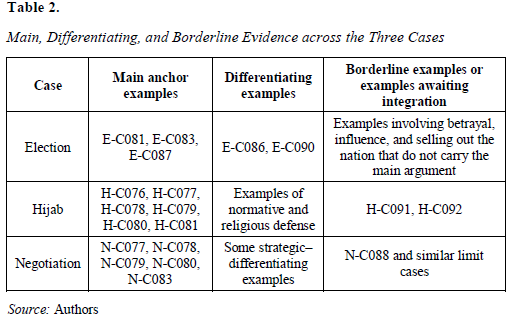
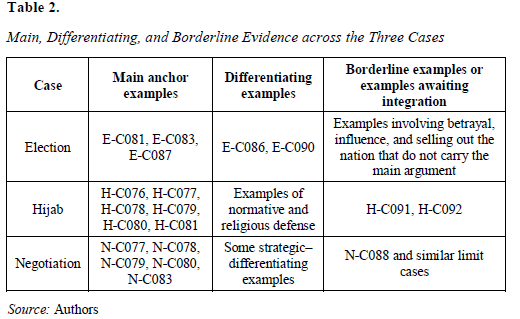
Placing the three cases side by side through the pattern of description, explanation, and analysis (summarized in Table 2) shows that their differences are not limited to the intensity of conflict. In the election case, the conflict rests on the fault line of legitimacy and belonging, positioning the rival as an actor implicated in a discredited scene. In the hijab case, the conflict is organized around coercion, dignity, and humiliation, and through this path reaches the moralization of conflict. In the negotiation case, the texts begin from strategic suspicion and only in a limited segment move toward the resistance–compromise fault line and then toward loyalty and betrayal. The differences among the three cases therefore appear in the distinct paths through which the relationship with the rival hardens and the language of conflict is shaped.
This account becomes more defensible when each case is examined as an actual field of conflict. In all three cases, the construction of the ‘rival’ emerges from the relation between the primary and countervailing sides, even where the analytical weight of those sides is not equal to that of the main anchors.
3. Discussion
Political antagonism on Persian X cannot be explained as a simple continuum running from lower to higher tension. The intensity of attacks, the harshness of labels, and the sharpness of tone clarify part of the problem, but the central issue lies in the kind of relationship that the text constructs with the political rival in each case. In the election case, the relationship hardens mainly through legitimacy and belonging. In the hijab case, this path runs through coercion, humiliation, and moral judgment about the punitive order. In the negotiation case, the hardening of the relationship appears as a limited slippage from strategic suspicion toward moral judgment about compromise and loyalty. The main difference among the three cases lies in these distinct paths through which the relationship with the rival hardens.
A second finding concerns the conceptual level. The present data show that disagreement over positions, ordinary boundary-making, othering, moralization of conflict, delegitimation, and political hatred do not overlap; each points to a different level of transformation in the relationship with the rival. Disagreement over positions may be intense, while the rival still remains within the horizon of political conflict. Ordinary boundary-making may be harsh and humiliating while still keeping the rival as a party to the conflict. Othering begins where the rival’s belonging, loyalty, or eligibility to participate becomes problematic. The moralization of conflict becomes prominent when the conflict is reconstructed in the language of justice and injustice, dignity and humiliation, or betrayal and loyalty. Delegitimation, in this account, is more often an outcome of these processes than an independent category. These distinctions matter because not every harsh discourse, humiliating example, or isolated exclusionary expression can immediately be placed at the highest level of erosion in the relationship with the rival. The third finding concerns method, since questions about the kind of relationship constructed with the rival, documented and auditable cluster-level analysis is usually more defensible than single-post reading. This point is especially important on a platform such as X, where textual compression, rapid recirculation, and the visibility of short phrases can push analysis toward hasty generalizations. A single post may be highly intense, but until its place in the interactional sequence and the logic of the cluster is clarified, the kind of relationship it constructs with the rival cannot be identified with sufficient precision. Limiting the main conclusion to clear evidentiary packages follows from this concern. This restriction is a condition for preserving the relation between the data and the final conclusion.
The same standard also exposes an asymmetry across the three cases. Because the negotiation case rests on a more limited and more dispersed evidentiary base than the election and hijab cases, its conclusions are held to a narrower scope rather than raised to the level supported elsewhere. Treating this unevenness openly, rather than smoothing it over, keeps the comparison within the limits of the evidence; this caution is part of the study’s analytical strength.
The relation between the findings and the existing literature also becomes clear along this path. The literature on affective polarization has rightly shown that the relationship with the rival is not defined only at the level of ideological distance. The data in this study extend this argument by showing that understanding the erosion of the relationship with the rival requires attention to how the rival is positioned in the text. The connection between polarization literature and discourse analysis matters at this point. Hostility toward the rival can appear in different relational forms, and without distinguishing among these forms, the analysis of online conflicts remains incomplete.
Another important point concerns the threshold of political hatred. In the data on Persian X, there are intense, humiliating, exclusionary forms of discourse, as well as forms of discourse that cast the rival as a spy. These forms of evidence are not sufficient to establish political hatred as the dominant logic. The study’s strict definition of political hatred performs important analytical work here, because it prevents intense formulations of betrayal, humiliation, or exclusion from being immediately elevated to political hatred. The present data therefore support claims about high levels of hostility, the moralization of conflict, and, in some cases, othering; speaking of political hatred as the dominant logic, however, is still not defensible.
This restraint can also be read in the ethical register introduced earlier. Had the threshold been set lower, the intense formulations of betrayal, humiliation, and exclusion documented across the three cases could readily have been certified as hatred; the strict threshold withholds that certification precisely where the evidence does not compel it. Read through Levinas, the negative finding is not a failure to detect something present, but a refusal to erase, through an act of analysis, the face that even harsh discourse leaves intact. The point is not that discourse on Persian X is mild — it frequently is not — but that the rival within it has not, on the available evidence, been reduced to an entity whose standing as a party to the conflict can be denied. In this sense, the empirical result and the ethical commitment converge: the data do not warrant the strongest category, and the strongest category is the one whose mistaken application would carry the heaviest cost.
The study also proceeds cautiously in relation to certain stronger readings. In limited areas of the data, especially in the supplementary examples from the election and negotiation cases, there are signs of movement from intra-political competition toward boundaries between insiders and outsiders. The available evidence is not sufficient to turn this observation into a central claim. In the hijab case as well, the dominant line still rests on dignity, humiliation, coercion, and autonomy, and there is not enough support to cast it as a dominant in-group/out-group pattern. This caution ensures that the conclusion does not move beyond the evidence.
The study’s position therefore lies at the intersection of conceptual distinction, empirical comparison, and methodological precision. The article distinguishes among different forms of erosion in the relationship with the rival, and shows that intensity of tone alone does not mark the boundary between them. The comparison of the three cases also shows that the relationship with the rival hardens along a different path in each case. Methodologically, the article’s judgments rely on documented and auditable cluster-level analysis and show that direct reliance on intense single posts, for this kind of question, expands the scope of the claim beyond what the data can support. Taken together, these elements allow the analysis to move beyond the description of a particular case and provide a more precise account of online political conflict.
4. Conclusion
This study began from the question of how the political rival is represented in conflicts on Persian X, and at what point this representation moves beyond disagreement over positions or ordinary boundary-making. The answer advanced here rests on the claim that the intensity of conflict alone is not sufficient for understanding online political conflict. What matters in these conflicts is the relationship constructed with the political rival.
The analysis of the three cases showed that their differences are not limited to the intensity of conflict. In the election case, the hardening of the relationship with the rival proceeds mainly through legitimacy and belonging. In the hijab case, this relationship hardens through coercion, humiliation, and moral judgment about the punitive order. In the negotiation case, the evidence is more dispersed and rests on a more limited evidentiary segment; here, only a narrow zone of slippage between strategic suspicion and moral judgment about compromise and surrender can be defended with caution. Because this case is supported less robustly than the other two, its reading is the most provisional of the three, and the comparison holds most firmly for the election and hijab cases. On this basis, the main difference among the three cases lies in the relational pattern of rival representation.
Conceptually, the article distinguishes among disagreement over positions, ordinary boundary-making, othering, moralization of conflict, and cases approaching the threshold of political hatred, without collapsing these concepts into one another. Methodologically, for a question of this kind, documented and auditable cluster-level analysis is more defensible than single-post reading. The article also does not move its claims beyond the available evidence. In the main corpus used here, political hatred is not established as the dominant logic in any of the three cases. This caution is part of the study’s analytical strength.
The main significance of the study lies in shifting the discussion from a general description of a “highly tense space” to a more precise account of the relationship constructed with the rival. Online conflicts cannot be understood by asking only how harsh the language is. The decisive question is what the rival becomes in the text under the pressure of that harshness — and whether, beneath that pressure, a face remains that the analysis has no warrant to erase.
Authorship Contribution Statement
All authors contributed equally to the conceptualization of the article and writing of the original and subsequent drafts. All authors have seen and approved the final version of the manuscript.
Declaration of the Use of AI and AI Assisted Technologies
This article was not authored by artificial intelligence.
Conflict of Interests and Funding
The authors certify that they have NO affiliations with or involvement in any organization or entity with any financial interest (such as honoraria; educational grants; participation in speakers’ bureaus; membership, employment, consultancies, stock ownership, or other equity interest; and expert testimony or patent-licensing arrangements), or non-financial interest (such as personal or professional relationships, affiliations, knowledge or beliefs affecting authors' objectivity) in the subject matter or materials discussed in this manuscript.
Ethical Considerations Statement
The authors avoided data fabrication, falsification, plagiarism, double publication/submission and any form of misconduct against publication ethics. Authors have properly cited all sources of ideas, words, and materials including pictures, charts, tables and statistics used in their paper. The study relies on public X data, but the public status of the data does not remove all ethical considerations. For this reason, the principles of harm minimization and minimization of identifiability were observed in the selection, paraphrasing, and extent of use of examples. Usernames, direct identifiers, and unnecessary identifiable details are not reproduced in the article. Where necessary, close but non-identifying paraphrase is used instead of full quotation.
Data Availability Statement
This study is based on public X posts and the reconstruction of documented and traceable interactional-discursive clusters. However, because of the political sensitivity of the research field and the risk that users could be re-identified through links, searchable texts, or combinations of contextual markers, the full raw dataset is not made publicly available. In accordance with the journal’s policy, a de-identified version of the correspondence table, together with the definition of the unit of analysis and the decision rules, is included as Supplementary File 1 for scholarly audit.
Acknowledgement
The authors would like to thank anonymous reviewers for their comments on the article.

| Article View | 274 |
| PDF Download | 158 |